
 五度妙笔
五度妙笔 企业透视镜
企业透视镜 API商城
API商城
 数据库
数据库D-Orbit Launches Wayfinder Mission on SpaceX Transporter-16 with ION Satellite Carrier
D-Orbit
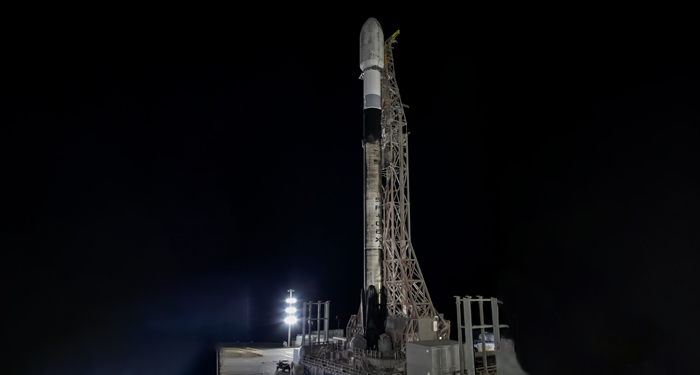
, a global leader in space logistics and orbital transportation, launched Wayfinder, the 22nd commercial mission of its orbital transfer vehicle (OTV),
ION Satellite Carrier (ION)
, aboard
SpaceX
’s Transporter-16 mission. The OTV was launched from Space Launch Complex 4E (SLC-4E) at Vandenberg Space Force Base in California at 4:02:00 a.m. PT (11:02:00 a.m. UTC). Following liftoff, ION SCV Astounding Alexandra was released into a
Sun-synchronous Orbit
at an altitude of approximately 510 km.
Wayfinder carries a diverse mission manifest, combining satellites destined for deployment into their operational orbits with hosted
payloads
undergoing in-orbit testing and demonstration. Upon reaching orbit, ION SCV Astounding Alexandra will join D-Orbit's growing fleet of ION vehicles already operating in space, further expanding the network supporting
D-Orbit
's Space Cloud services and in-orbit computing capabilities.
“Wayfinder reflects the full range of what ION is built to do, deploying satellites into their operational slots while simultaneously hosting payloads that need time and conditions in orbit to prove their technology, enriching our in-orbit infrastructure with new nodes for our Space Cloud services,"
said Matteo Andreas Lorenzoni, Director of D-Orbit Orbital Access Business Unit.
“This is what sets ION apart: a single mission that delivers real value across multiple customers and use cases, making access to orbit faster, smarter, and more cost-effective for everyone on board.
ION Satellite Carrier is a versatile
space vehicle
capable of transporting and releasing satellites into distinct orbital slots. It can also accommodate third-party
payloads
, including innovative technologies, research experiments, and instruments requiring in-orbit testing. Additionally, ION can support edge computing and space cloud services, providing satellite operators with advanced storage and computational capabilities in orbit.
D-Orbit
's mission control team is now conducting the Launch and Early Orbit Phase (LEOP), setting the stage for the upcoming operational phase.
Collaborating with New and Recurring Passengers
ION carries:
Camões, Agustina, Saramago, and Pessoa (Lusospace):
The four 8U satellites will join PoSAT-2, already in orbit, marking the beginning of Lusíada, LusoSpace's 12-satellite constellation designed to advance maritime communications through VDES technology, delivering higher bandwidth, enhanced data integrity, and improved safety over current AIS-based systems.
Camera SpaceMast (DLR Space Mast):
The Camera SpaceMast is an ultra-lightweight deployable carbon composite mast system designed to validate in-orbit deployment and retraction mechanics while demonstrating on-orbit imaging capabilities. Extending up to 3.5 meters from the hosting OTV, the system will position two cameras to capture wide-angle footage of spacecraft operations, including
payload
deployments and wide-angle views of the spacecraft operations with Earth in the background.
QubitCore (Qubitrium):
QubitCore is a compact,
CubeSat
-compatible payload designed for space-based quantum communication missions. The system enables secure quantum key distribution (QKD) experiments and demonstrations in orbit, contributing to the development of next-generation encrypted communication infrastructure from space.
Expanding the mission manifest, on three additional ports of the Transporter-16 mission,
D-Orbit
is also launching:
OPTISAT, a 6U CubeSat mission designed, developed, and operated under the lead of Planetek Hellas to demonstrate optical secure connectivity technologies. The mission is implemented under a contract with the
European Space Agency
and supported by the Hellenic Ministry of Digital Governance as part of Greece’s national satellite capability development program.
GEMS2-Amethyst by Weather Stream, a second-generation dual-band passive microwave radiometer with expanded spectral coverage, is designed to observe global weather through the retrieval of atmospheric temperature, moisture, and precipitation profiles. Building on prior mission heritage, the system expands the global weather observing system, supporting improved numerical weather prediction, environmental monitoring, and operational decision-making for government and commercial users.
ISISPACE
and D-Orbit cooperated to provide deployer equipment and integration services to support the launch of two satellites, among which the PARUS-6U1 mission on behalf of the
Taiwan Space Agency (TASA)
. As the latest mission in the PARUS satellite series - following PARUS-T1 and PARUS-T2 - PARUS-6U1 continues the programme’s educational demonstration objectives, with a particular focus on ionospheric research.
With this launch,
D-Orbit
has now deployed more than 220
payloads
in orbit since the inaugural ION mission in 2020, establishing itself as a trusted partner for satellite deployment, in-orbit testing, and space logistics services.
Click here to know more about D-Orbit's ION Satellite Bus Specs
Publisher:
SatNow
236
48


