
 五度妙笔
五度妙笔 企业透视镜
企业透视镜 API商城
API商城
 数据库
数据库【论文推荐】| 基于物理信息神经网络的地形反演及波浪场重构方法研究
论文导读与观点概要
1. 研究背景与目的
准确获取海底地形及近岸波浪场数据对海洋工程与资源勘探至关重要。然而,传统测量手段(如船载声呐、潜水器)存在成本高、周期长及空间覆盖率低的瓶颈;现有的遥感反演算法(如cBathy)在处理稀疏数据时存在局限,而数据同化技术则计算消耗巨大。为此,本研究旨在提出一种基于物理信息神经网络(PINNs)的新型反演方法,以突破传统技术在成本与数据密度方面的限制,实现复杂地形条件下高精度、低成本的海底地形反演及波浪场重构。
2. 研究方法
本研究构建了一种融合物理机制与数据驱动的PINNs模型。核心方法包括:
3. 核心结果
实验结果表明,PINNs模型在多种地形下均表现出优异的反演与重构能力:
4. 结论
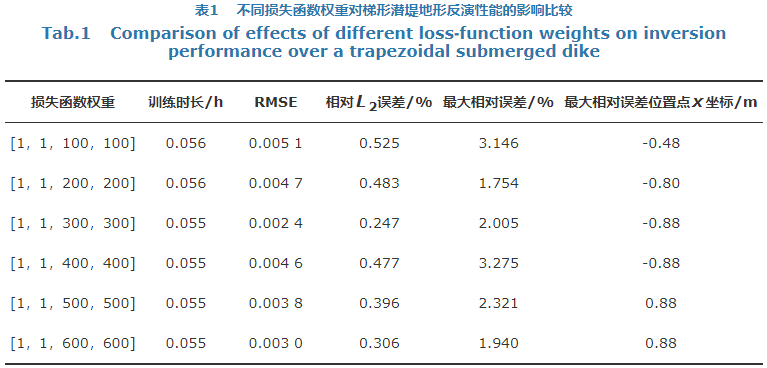
基于物理信息神经网络构建地形反演及波浪场重构模型,系统讨论了网络架构参数、损失函数权重配置及数据稀疏性对模型反演性能的影响,并探讨了物理约束对反演问题的增强效应。主要结论如下:
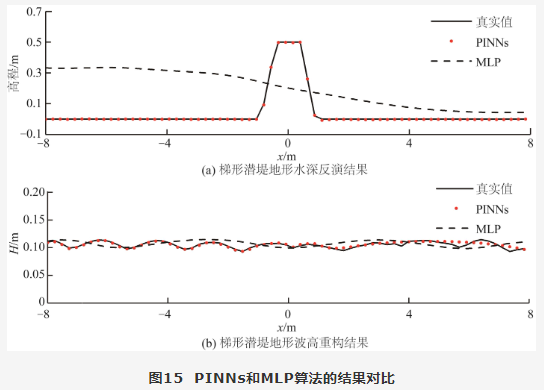
1)通过将能量平衡方程与线性色散关系融入神经网络损失函数,结合稀疏流场数据,该模型实现了复杂地形条件下的水深反演及波场重建;在低分辨率数据条件下,模型仍保持相对L2误差低于2%的精度,物理与数据双驱动机制有效弥补了观测数据空间稀疏性的制约。
2)合理的网络参数配置对模型性能造成显著影响,网络的最优架构需根据具体问题的时空复杂度进行动态调整,以提升训练稳定性。
3)针对地形突变区域精度不足问题,采用基于损失函数残差的自适应采样策略,使模型精度显著提升,为近岸地形反演中监测点布设方案设计提供参考。
相较于传统离散化测量技术,模型实现了全域连续流场特征重建,对海洋地形测绘具有一定参考价值。
相关图表
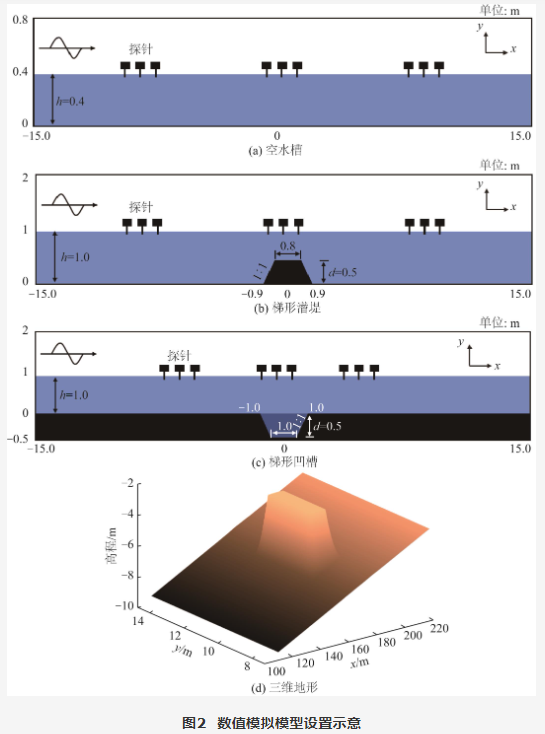
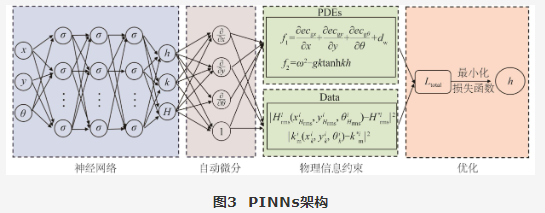
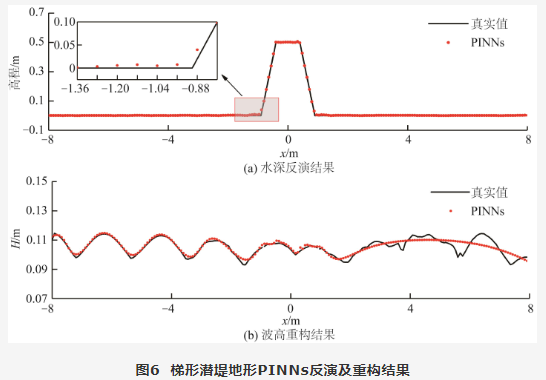
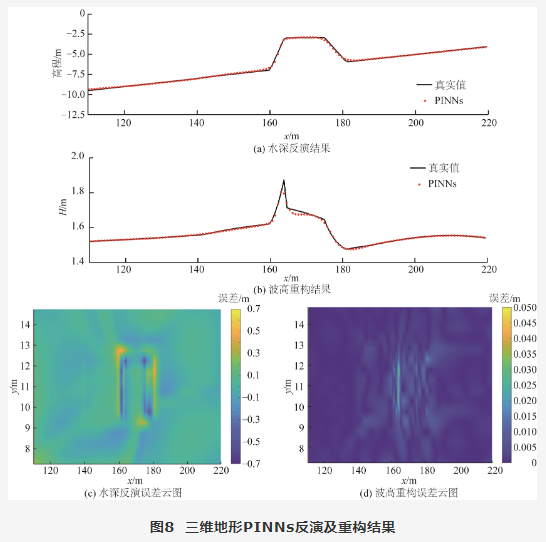

本文引用格式:叶杨莎, 邓争志, 边鑫, 等. 基于物理信息神经网络的地形反演及波浪场重构方法研究[J]. 海洋工程, 2026, 44(3): 124-138. (YE Yangsha, DENG Zhengzhi, BIAN Xin, et al. Topography inversion and wave-field reconstruction method based on physics-informed neural networks[J]. The Ocean Engineering, 2026, 44(3): 124-138. (in Chinese))
作者简介:
叶杨莎(1999—),女,浙江丽水人,硕士研究生,研究方向为海洋工程AI应用。E-mail: yash.ye@zju.edu.cn
参考文献
1
孙和平, 李倩倩, 鲍李峰, 等. 全球海底地形精细建模进展与发展趋势[J]. 武汉大学学报(信息科学版), 2022, 47(10): 1555-1567.
SUN H P, LI Q Q, BAO L F, et al. Progress and development trend of global refined seafloor topography modeling[J]. Geomatics and Information Science of Wuhan University, 2022, 47(10): 1555-1567. (in Chinese)
2
DE MOUSTIER C. Field evaluation of sounding accuracy in deep water multibeam swath bathymetry[C]//MTS/IEEE Oceans 2001. An Ocean Odyssey. Honolulu: IEEE, 2001: 1761-1765.
3
MARKS K M, SMITH W H F. An uncertainty model for deep ocean single beam and multibeam echo sounder data[J]. Marine Geophysical Researches, 2008, 29(4): 239-250.
4
ZWALLY H J, SCHUTZ B, ABDALATI W, et al. ICESat’s laser measurements of polar ice, atmosphere, ocean, and land[J]. Journal of Geodynamics, 2002, 34(3/4): 405-445.
5
刘焱雄, 郭锴, 何秀凤, 等. 机载激光测深技术及其研究进展[J]. 武汉大学学报(信息科学版), 2017, 42(9): 1185-1194.
LIU Y X, GUO K, HE X F, et al. Research progress of airborne laser bathymetry technology[J]. Geomatics and Information Science of Wuhan University, 2017, 42(9): 1185-1194. (in Chinese)
6
WYNN R B, HUVENNE V A I, LE BAS T P, et al. Autonomous underwater vehicles (AUVs): their past, present and future contributions to the advancement of marine geoscience[J]. Marine Geology, 2014, 352: 451-468.
7
KELLY C, KERBY T, SARRANDIN P M, et al. Submersibles and remotely operated vehicles[M]// CLARKMR,CONSALVEYM,ROWDENAA.Biological Sampling in the Deep Sea, [S.l]:John Wiley & Sons, Ltd., 2016: 285-305.
8
李森, 张文静, 王岗, 等. 基于遥感海浪信息的近岸水深反演模型[J]. 海洋技术学报, 2023, 42(2): 1-11.
LI S, ZHANG W J, WANG G, et al. Nearshore water depth inverting model based on remote sensing wave information[J]. Journal of Ocean Technology, 2023, 42(2): 1-11. (in Chinese)
9
GALLEGO G, YEZZI A, FEDELE F, et al. A variational stereo method for the three-dimensional reconstruction of ocean waves[J]. IEEE Transactions on Geoscience and Remote Sensing, 2011, 49(11): 4445-4457.
10
HOLMAN R, PLANT N, HOLLAND T. CBathy: a robust algorithm for estimating nearshore bathymetry[J]. Journal of Geophysical Research: Oceans, 2013, 118(5): 2595-2609.
11
WILSON G W, ÖZKAN-HALLER H T, HOLMAN R A, et al. Surf zone bathymetry and circulation predictions via data assimilation of remote sensing observations[J]. Journal of Geophysical Research: Oceans, 2014, 119(3): 1993-2016.
12
BERGSMA E W J, CONLEY D C, DAVIDSON M A, et al. Storm event to seasonal evolution of nearshore bathymetry derived from shore-based video imagery[J]. Remote Sensing, 2019, 11(5): 519.
13
LEE J, DEVORE K, HESSER T, et al. Blending bathymetry: combination of image-derived parametric approximations and celerity data sets for nearshore bathymetry estimation[J]. Coastal Engineering, 2024, 192: 104546.
14
SOTO F, CATALAN P. Bathymetry inversion in the surf zone via assimilation of remotely sensed wave breaking energy dissipation[C]// Proceedings of Virtual Conference on Coastal Engineering: Coastal Engineering 2020. [S.l.]: Virtual Local Organizing Committee, 2020: 36v.
15
NARDI L, SORROR C, BADRAN F, et al. YAO: a software for variational data assimilation using numerical models[C]// Proceedings of the International Conference on Computational Science and Its Applications: Part II (ICCSA2009). Berlin, Heidelberg: Springer-Verlag, 2009: 621-636.
16
LE DIMET F X, SOUOPGUI I, NGODOCK H E. Sensitivity analysis applied to a variational data assimilation of a simulated pollution transport problem[J]. International Journal for Numerical Methods in Fluids, 2017, 83(5): 465-482.
17
XIAO Y, FRIEDRICHS M A M. Using biogeochemical data assimilation to assess the relative skill of multiple ecosystem models in the Mid-Atlantic Bight: effects of increasing the complexity of the planktonic food web[J]. Biogeosciences, 2014, 11(11): 3015-3030.
18
马子炜, 郭孝先, 卢文月, 等. 基于深度学习自编码器的X波段雷达二维波浪场实时重构方法研究[J]. 水动力学研究与进展A辑, 2024, 39(3): 414-424.
MA Z W, GUO X X, LU W Y, et al. Research on real-time reconstruction method of two-dimensional wave field of X-band radar based on deep learning autoencoder[J]. Chinese Journal of Hydrodynamics, 2024, 39(3): 414-424. (in Chinese)
19
DUAN W Y, YANG K, HUANG L M, et al. Numerical investigations on wave remote sensing from synthetic X-band radar sea clutter images by using deep convolutional neural networks[J]. Remote Sensing, 2020, 12(7): 1117.
20
李蒙, 刘曾. 基于双目立体视觉数据的波浪场重构研究[J]. 海洋工程, 2024, 42(5): 157-164.
LI M, LIU Z. Research on wave field reconstruction based on binocular stereoscopic vision data[J]. The Ocean Engineering, 2024, 42(5): 157-164. (in Chinese)
21
RAISSI M, PERDIKARIS P, KARNIADAKIS G. Physics informed deep learning (Part I): data-driven solutions of nonlinear partial differential equations[EB/OL]. (2017-11-28) [2024-12-15]. https://arxiv.org/abs/1711.10561.
22
RAISSI M, PERDIKARIS P, KARNIADAKIS G. Physics informed deep learning (Part Ⅱ): data-driven solutions of nonlinear partial differential equations[EB/OL]. (2017-11-28) [2024-12-15]. https://arxiv.org/abs/1711.10566.
23
RAISSI M, PERDIKARIS P, KARNIADAKIS G E. Physics-informed neural networks: a deep learning framework for solving forward and inverse problems involving nonlinear partial differential equations[J]. Journal of Computational Physics, 2019, 378: 686-707.
24
RAISSI M, WANG Z C, TRIANTAFYLLOU M S, et al. Deep learning of vortex-induced vibrations[J]. Journal of Fluid Mechanics, 2019, 861: 119-137.
25
RAO C P, SUN H, LIU Y. Physics-informed deep learning for incompressible laminar flows[J]. Theoretical and Applied Mechanics Letters, 2020, 10(3): 207-212.
26
MAO Z P, JAGTAP A D, KARNIADAKIS G E. Physics-informed neural networks for high-speed flows[J]. Computer Methods in Applied Mechanics and Engineering, 2020, 360: 112789.
27
唐明健, 唐和生. 基于物理信息的深度学习求解矩形薄板力学正反问题[J]. 计算力学学报, 2022, 39(1): 120-128.
TANG M J, TANG H S. A physics-informed deep learning method for solving forward and inverse mechanics problems of thin rectangular plates[J]. Chinese Journal of Computational Mechanics, 2022, 39(1): 120-128. (in Chinese)
28
靳放, 郑素佩, 封建湖, 等. 求解浅水波方程的并行物理信息神经网络算法[J]. 计算力学学报, 2024, 41(2): 352-358.
JIN F, ZHENG S P, FENG J H, et al. Concurrent PINN algorithm for solving shallow water wave equations[J]. Chinese Journal of Computational Mechanics, 2024, 41(2): 352-358. (in Chinese)
29
JANSSEN T T, BATTJES J A. A note on wave energy dissipation over steep beaches[J]. Coastal Engineering, 2007, 54(9): 711-716.
END
期刊简介
本刊是全国中文核心期刊,中国科技核心期刊,《中国科学引文数据库》(CSCD)核心期刊,CSCIED科技核心期刊,美国《剑桥科学文摘》(CSA)、日本科学技术振兴机构数据库(JST)、科技期刊世界影响力指数(WJCI)等收录期刊,中国科技论文统计源期刊等。
先后荣获中国国际影响力优秀学术期刊、国家级优秀海洋期刊、学术影响力进步期刊、第八届华东地区优秀期刊、江苏期刊明珠奖·优秀期刊(2025)、中国科技期刊卓越行动计划二期集群(集团)化试点项目(A类)集群期刊、中国科协高水平中文期刊培育项目资助等荣誉。
联系方式
地址:江苏省南京市鼓楼区虎踞关34号《海洋工程》编辑部
邮箱:oe@nhri.cn
电话:025-85829332
关注我们

期刊公众号

期刊官网

作者QQ交流群


