
 五度妙笔
 企业透视镜
 API商城

 数据库
【海洋工程管道专题】| 非黏结柔性管新型仿生骨架层抗冲蚀性能分析
论文导读与观点概要
一、研究目的
随着我国海洋油气开发由浅海迈向深海、超深水,南海等海域70%以上的油气资源埋藏于水深500 m乃至1500 m以深的海域,对海底集输管道的安全性与耐久性提出了前所未有的苛刻要求。非黏结柔性管是深海油气开采的关键结构,其最内层的骨架层通常由不锈钢钢带缠绕而成,承担抵抗外压、防止管体压溃失效的核心功能,但其波纹状、缓波形的非光滑内表面,加之采出油气中携带的细砂颗粒,使其成为整条管道中最易遭受冲蚀损伤的薄弱环节。一旦骨架层局部被冲出沟槽,极易诱发外压屈曲与疲劳断裂,酿成重大经济损失与海洋环境污染。然而,现有研究多聚焦于"流动参数如何影响骨架层冲蚀",对"如何主动降低骨架层冲蚀"缺乏有效手段;已有的涂层、表面硬化等材料保护方案成本高、开发周期长,而融合仿生表面来提升柔性管抗冲蚀能力的研究近乎空白。基于此,本研究受沙漠蝎子、沙漠红柳、鲨鱼皮等天然抗冲蚀生物结构启发,创新性提出三种仿生沟槽骨架层结构,旨在从结构优化角度为柔性管道骨架层的抗冲蚀设计提供全新的理论依据与工程思路。
二、研究方法
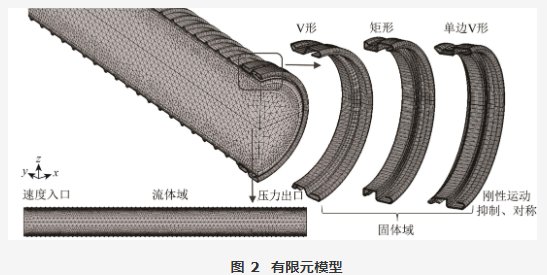
研究团队基于仿生学原理构建了 V形、矩形、单边V形 三种新型沟槽骨架层结构,三者由单元互锁成型,并统一设定沟槽间距、入口宽度与深度为9 mm、7 mm、2.5 mm,以保证单一变量对比。骨架层材料选用工程中常用的316L不锈钢,模型管内径50.8 mm、管长1 m(为捕捉20 m/s流速下的最大冲蚀,局部增至5 m),并依据对称性建立1/2简化模型,在验证三维模型冲蚀分布集中于对称面后,将后续计算合理简化为二维模型以兼顾精度与效率。数值方法上,采用计算流体力学与拉格朗日粒子追踪相结合的求解框架:连续相流场由雷诺平均纳维–斯托克斯(RANS)方程配合k-ε湍流模型求解,离散相颗粒轨迹通过受力微分方程(含拖曳力、重力、压力梯度力及附加质量力)预测,并采用Mansouri等基于316不锈钢开发、经自定义函数嵌入COMSOL Multiphysics 的专用冲蚀模型进行损伤计算;颗粒与壁面碰撞引入Grant–Tabakoff随机反弹模型,释放粒子数达20000个。研究系统开展了网格收敛性验证,并围绕骨架层形状、流速(0~30 m/s)、颗粒质量流率(0.1、0.2 g/s)、粒径(100~600 μm) 四大因素展开参数化对比分析,同时与原始骨架层及Finnie、E/CRC、DNV等经典模型进行横向校核。
三、主要结果
研究表明,三种仿生沟槽均能改变颗粒运动轨迹与撞击角度,其中单边V形骨架层在高流速工况(20~25 m/s)下表现最优,最大冲蚀速率较原始结构降低37%,且整体平均冲蚀率同步下降;抗冲蚀性能总体排序为单边V形>原始>V形>矩形。冲蚀热点集中分布于骨架层沟槽前缘区域(钢带前沿),其损伤程度取决于局部流动特性与沟槽几何形状——此处颗粒未经碰撞反弹、动能衰减少,且撞击角度更接近316L不锈钢冲蚀峰值角(约30°),故冲蚀最为剧烈。进一步分析揭示:在中低流速(0~15 m/s)下V形结构更具优势;颗粒质量流率的增加会使冲蚀速率近似线性增长,但并不改变各仿生结构的相对抗冲蚀排序;粒径影响则呈现非单调的复杂规律,与光滑管道的线性增长明显不同——大粒径(500~600 μm)下单边V形抗冲蚀最佳,高流速小粒径(100~400 μm)下V形更优。机理分析表明,仿生沟槽通过几何构型与局部流场双重作用改变颗粒撞击角度,使其偏离最大冲蚀角,是抗冲蚀性能提升的根本原因。此外,经典Finnie、E/CRC、DNV模型均严重低估316L不锈钢的冲蚀损伤,若用于指导余量设计将导致结构提前失效。
四、结论与意义
本研究首次将仿生表面构型引入非黏结柔性管骨架层抗冲蚀设计,证实了"以结构减蚀"路径的可行性与显著效果。研究得出三点核心结论:其一,V形与单边V形骨架层能在多工况下降低颗粒在沟槽内的碰撞位置与次数、有效保护光滑管段,而矩形结构在多数工况下抗冲蚀性能较差,工程上不建议选用;其二,结构选型应与工况匹配——高流速优先选单边V形(最大冲蚀降37%)、中低流速优先选V形,但二者存在的直角拐点与较大弯曲角可能在轧制成型阶段带来困难,需进一步优化;其三,流速、质量流率与粒径的变化不改变仿生骨架层的相对抗冲蚀优劣,仿生几何形状才是决定抗冲蚀效果的最主要因素。该成果为柔性管道骨架层的抗冲蚀优化设计提供了可靠的数值分析方法与数据参考,可显著提升深海柔性管的服役耐久性,同时为弯头、三通、异径管等冲蚀敏感区域的局部结构优化开辟了新思路,具有重要的工程推广价值。
一句话推荐语: 受仿生结构启发,为深海柔性管穿上"抗冲蚀铠甲"——单边V形仿生骨架层可在高流速下将最大冲蚀速率降低37%,为深海油气安全集输提供全新减蚀方案。
相关图表




本文引用格式:王华昆, 邓凌, 张尧. 非黏结柔性管新型仿生骨架层抗冲蚀性能分析[J]. 海洋工程, 2026, 44(5): 1-13. (WANG Huakun, DENG Ling, ZHANG Yao. Erosion resistance analysis of novel bionic carcass layer in unbonded flexible pipes[J]. The Ocean Engineering, 2026, 44(5): 1-13. (in Chinese))
作者简介:
王华昆(1991—),男,福建人,博士,副教授,主要从事多相流冲刷腐蚀及结构损伤多场耦合仿真研究。E-mail:hkwang@xmu.edu.cn
参考文献
1
阎军, 英玺蓬, 步宇峰, 等. 深水柔性立管结构技术进展综述[J]. 海洋工程装备与技术, 2019, 6(6): 745-749.
YAN J, YING X P, BU Y F, et al. Summary of development of flexible riser structural technology in deep water[J]. Ocean Engineering Equipment and Technology, 2019, 6(6): 745-749. (in Chinese)
2
陈严飞, 刘昊, 曹静, 等. 考虑轴向荷载和外压影响的非黏结柔性管道骨架层失效分析[J]. 海洋工程, 2022, 40(1): 125-133.
CHEN Y F, LIU H, CAO J, et al. Collapse failure of carcass for un-bonded flexible pipe considering axial loading and external pressure[J]. The Ocean Engineering, 2022, 40(1): 125-133. (in Chinese)
3
李兰, 张荫纳. 静态柔性软管弯曲加强器的设计[J]. 海洋工程装备与技术, 2014, 1(3): 223-226.
LI L, ZHANG Y N. Design of static bend stiffener for flexible pipes[J]. Ocean Engineering Equipment and Technology, 2014, 1(3): 223-226. (in Chinese)
4
陈严飞, 刘昊, 孙伟栋, 等. 柔性管道骨架层压溃失效机理和安全评价方法研究进展[J]. 海洋工程, 2021, 39(4): 154-162.
CHEN Y F, LIU H, SUN W D, et al. A review on collapse failure mechanism and safety evaluation of flexible pipes carcass[J]. The Ocean Engineering, 2021, 39(4): 154-162. (in Chinese)
5
BRAESTRUP M W, ANDERSEN J B, ANDERSEN L W, et al. Design and installation of marine pipelines[M]. [S.l.]:John Wiley & Sons, 2009.
6
HELGAKER J F, IJZERMANS S, LANDHEIM T J, et al. Large-scale erosion testing of an unbonded flexible pipe[J]. SPE Journal, 2017, 22(3): 736-745.
7
ZHANG Z L, ZHANG Y, LIU Y B, et al. Experimental study on erosion of full-scale unbonded flexible subsea pipe[C]//Proceedings of the Thirty-third(2023) International Ocean and Polar Engineering Conference. [S.l.]:ISOPE, 2023: ISOPE-I-23-244.
8
WONG C Y, SOLNORDAL C B, MORAND H. Flexible pipe erosion modelling[C]//Proceedings of the 11th International Conference on CFD in the Minerals and Process Industries. Melbourne, Australia: CSIRO, 2015:1-7.
9
秦桦. 非粘结性柔性管骨架层冲蚀磨损分析[D]. 北京: 中国石油大学(北京), 2019.
QIN H. Erosion analysis of carcass layer of non-cohesive flexible pipe[D]. Beijing: China University of Petroleum (Beijing), 2019. (in Chinese)
10
AN C, GU C W, QIN H, et al. An analysis of carcass layer erosion in un-bonded flexible offshore pipework[J]. International Journal of Maritime Engineering, 2021, 163(A1): 63-77.
11
YU J X, LI H D, YU Y, et al. Numerical investigation of liquid-solid erosion in unbonded flexible pipes[J]. International Journal of Pressure Vessels and Piping, 2022, 199: 104743.
12
WANG H K, DENG L, ZHANG Y, et al. A comprehensive review on erosion-corrosion characteristics of steel subjected to tensile stress[J]. Journal of Iron and Steel Research International, 2025, 32: 1781-1802.
13
CHANG S H, TANG T P, HUANG K T. Improvement of aluminum erosion behavior and corrosion resistance of AISI H13 tool steel by oxidation treatment[J]. ISIJ International, 2010, 50(4): 569-573.
14
ABD-ELRHMAN Y M, ABOUEL-KASEM A, EMARA K M, et al. Effect of impact angle on slurry erosion behavior and mechanisms of carburized AISI 5117 steel[J]. Journal of Tribology, 2014, 136: 011106.
15
SINGH A, VIRDI R L, GOYAL K. To study the slurry erosion behaviour of hard faced alloy SS304[J]. Materials Science and Technology, 2014, 2(6): 111-115.
16
ZHENG L, WU J J, ZHANG S, et al. Bionic coupling of hardness gradient to surface texture for improved anti-wear properties[J]. Journal of Bionic Engineering, 2016, 13(3): 406-415.
17
OJALA N, VALTONEN K, ANTIKAINEN A, et al. Wear performance of quenched wear resistant steels in abrasive slurry erosion[J]. Wear, 2016, 354: 21-31.
18
OJALA N, VALTONEN K, MINKKINEN J, et al. Edge and particle embedment effects in low- and high-stress slurry erosion wear of steels and elastomers[J]. Wear, 2017, 388: 126-135.
19
DUARTE C A R, DE SOUZA F J. Innovative pipe wall design to mitigate elbow erosion: a CFD analysis[J]. Wear, 2017, 380: 176-190.
20
DUARTE C A R, DE SOUZA F J, DOS SANTOS V F. Mitigating elbow erosion with a vortex chamber[J]. Powder Technology, 2016, 288: 6-25.
21
HAN Z W, ZHANG J Q, GE C, et al. Gas-solid erosion on bionic configuration surface[J]. Journal of Wuhan University of Technology-Mater Sci Ed, 2011, 26(2): 305-310.
22
ZHANG J Q, CHEN W N, YANG M K, et al. The ingenious structure of scorpion armor inspires sand-resistant surfaces[J]. Tribology Letters, 2017, 65(3): 110.
23
YU H Y, SHAO L T, ZHANG S J, et al. A new erosive wear resistance strategy for curved surfaces based on combined bionics[J]. Tribology International, 2023, 180: 108226.
24
BAI X P, YAO Y M, HAN Z W, et al. Study of solid particle erosion on helicopter rotor blades surfaces[J]. Applied Sciences, 2020, 10(3): 977.
25
YIN W, HAN Z W, FENG H L, et al. Gas-solid erosive wear of biomimetic pattern surface inspired from plant[J]. Tribology Transactions, 2017, 60(1): 159-165.
26
JUNG S, YANG E, JUNG W, et al. Anti-erosive mechanism of a grooved surface against impact of particle-laden flow[J]. Wear, 2018, 406: 166-172.
27
GUO Z H, ZHANG J, LI H, et al. A comprehensive evaluation of the anti-erosion characteristics of several new structural elbows in the pneumatic conveying system[J]. Powder Technology, 2022, 412: 117976.
28
阎军, 张恒瑞, 李文博, 等. 基于数据驱动的柔性立管骨架层多目标优化[J]. 哈尔滨工程大学学报, 2023, 44(5): 689-697.
YAN J, ZHANG H R, LI W B, et al. Data-driven multiobjective optimization of a flexible riser carcass layer[J]. Journal of Harbin Engineering University, 2023, 44(5): 689-697. (in Chinese)
29
LIU Y H, GUAN F, WAN F. Crushing resistance analysis and cross-sectional parameters optimization of flexible pipe carcass layer[J]. Journal of Failure Analysis and Prevention, 2021, 21: 880-889.
30
HAN Z W, YIN W, ZHANG J Q, et al. Erosion-resistant surfaces inspired by tamarisk[J]. Journal of Bionic Engineering, 2013, 10(4): 479-487.
31
XIAO G J, HE Y, HUANG Y, et al. Shark-skin-inspired micro-riblets forming mechanism of TC17 titanium alloy with belt grinding[J]. IEEE Access, 2019, 7: 107635-107647.
32
陈平, 项欣, 李俊玲, 等. 沟槽型织构摩擦学性能的数值模拟与实验研究[J]. 材料工程, 2016, 44(6): 31-37.
CHEN P, XIANG X, LI J L, et al. Experimental and numerical investigation on tribological performance of grooved texture[J]. Journal of Materials Engineering, 2016, 44(6): 31-37. (in Chinese)
33
QIAO L D, XIA R, LI B, et al. Effect of groove textures on wear of friction pair between groove side and scraper under different factor combinations[J]. Proceedings of the Institution of Mechanical Engineers, Part J: Journal of Engineering Tribology, 2025, 239(3): 307-315.
34
GAY NETO A, DE ARRUDA MARTINS C. A comparative wet collapse buckling study for the carcass layer of flexible pipes[J]. Journal of Offshore Mechanics and Arctic Engineering, 2012, 134(3): 031701.
35
WANG H K, ZHAO X Y, YU Y, et al. Numerical simulation method of erosion-corrosion of high-pressure X65 pipe bends in CO2 corrosion environment[J]. Multiscale and Multidisciplinary Modeling, Experiments and Design, 2024, 7(3): 2461-2487.
36
WANG H K, YU Y, YU J X, et al. Effect of pitting defects on the buckling strength of thick-wall cylinder under axial compression[J]. Construction and Building Materials, 2019, 224: 226-241.
37
CAO X W, XIONG N, LI J, et al. Experimental study on the erosion of pipelines under different load conditions[J]. Fluid Dynamics & Materials Processing, 2022, 18(2): 233-241.
38
Matweb. AISI type 316L stainless steel, annealed sheet [ED/OL]. [2024-07-29]. http://www.matweb.com/.
39
WANG H K, YU Y, XU Y Z, et al. A unified model and simulation method for elastoplastic stress-erosion interaction[J]. Tribology International, 2024, 191: 109111.
40
DNV. Erosive wear in piping systems: DNV-RP-O501:2015[S]. Høvik: Det Norske Veritas, 2007.
41
MANSOURI A, ARABNEJAD H, SHIRAZI S A, et al. A combined CFD/experimental methodology for erosion prediction[J]. Wear, 2015, 332: 1090-1097.
42
MANSOURI A. A combined CFD-experimental method for developing an erosion equation for both gas-sand and liquid-sand flows [D]. Tulsa: The University of Tulsa, 2016.
43
XU W P, WANG H K, YU Y, et al. Study on applicability of microgroove erosion mitigation method based on stress-erosion coupling simulation[J]. Tribology International, 2022, 174: 107746.
44
GRANT G, TABAKOFF W. Erosion prediction in turbomachinery resulting from environmental solid particles[J]. Journal of Aircraft, 1975, 12(5): 471-478.
45
ZHANG J X, KANG J, FAN J C, et al. Study on erosion wear of fracturing pipeline under the action of multiphase flow in oil & gas industry[J]. Journal of Natural Gas Science and Engineering, 2016, 32: 334-346.
46
WANG H K, YU Y, YU J X, et al. Numerical simulation of the erosion of pipe bends considering fluid-induced stress and surface scar evolution[J]. Wear, 2019, 440: 203043.
47
DOROODCHI E, EVANS G M, SCHWARZ M P, et al. Influence of turbulence intensity on particle drag coefficients[J]. Chemical Engineering Journal, 2008, 135(1/2): 129-134.
END
期刊简介
本刊是全国中文核心期刊,中国科技核心期刊,《中国科学引文数据库》(CSCD)核心期刊,CSCIED科技核心期刊,美国《剑桥科学文摘》(CSA)、日本科学技术振兴机构数据库(JST)、科技期刊世界影响力指数(WJCI)等收录期刊,中国科技论文统计源期刊等。
先后荣获中国国际影响力优秀学术期刊、国家级优秀海洋期刊、学术影响力进步期刊、第八届华东地区优秀期刊、江苏期刊明珠奖·优秀期刊(2025)、中国科技期刊卓越行动计划二期集群(集团)化试点项目(A类)集群期刊、中国科协高水平中文期刊培育项目资助等荣誉。
联系方式
地址:江苏省南京市鼓楼区虎踞关34号《海洋工程》编辑部
邮箱:oe@nhri.cn
电话:025-85829332
关注我们

期刊公众号

期刊官网

作者QQ交流群


