
 五度妙笔
五度妙笔 企业透视镜
企业透视镜 API商城
API商城
 数据库
数据库Meta Releases TRIBE v2: A Brain Encoding Model That Predicts fMRI Responses Across Video, Audio, and Text Stimuli
Neuroscience has long been a field of divide and conquer. Researchers typically map specific cognitive functions to isolated brain regions—like motion to area V5 or faces to the fusiform gyrus—using models tailored to narrow experimental paradigms. While this has provided deep insights, the resulting landscape is fragmented, lacking a unified framework to explain how the human brain integrates multisensory information.
Meta’s FAIR team has introduced
TRIBE v2
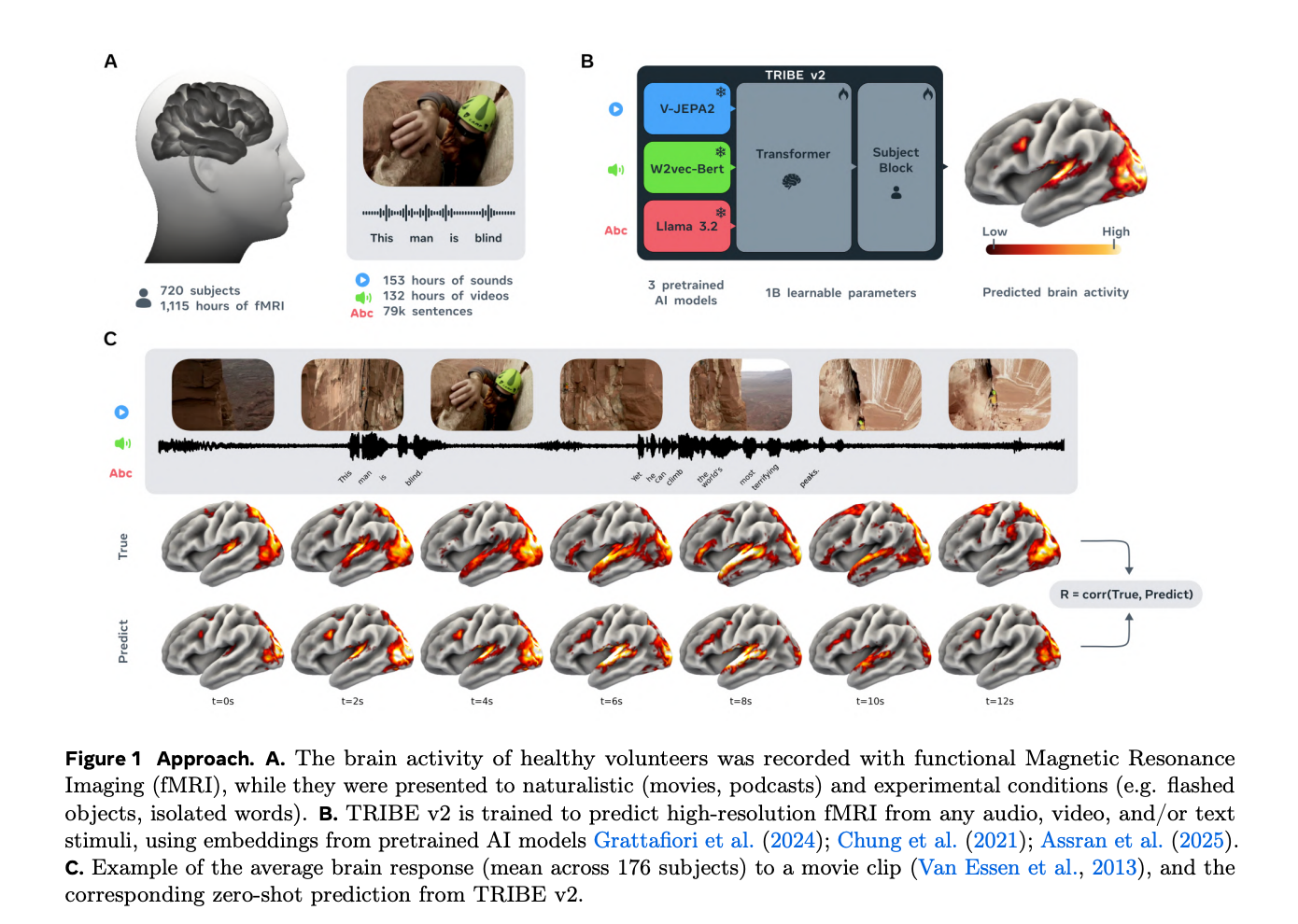
, a tri-modal foundation model designed to bridge this gap. By aligning the latent representations of state-of-the-art AI architectures with human brain activity, TRIBE v2 predicts high-resolution fMRI responses across diverse naturalistic and experimental conditions.
The Architecture: Multi-modal Integration
TRIBE v2 does not learn to ‘see’ or ‘hear’ from scratch. Instead, it leverages the representational alignment between deep neural networks and the primate brain. The architecture consists of three frozen foundation models serving as
feature extractors
,
a temporal transformer,
and a
subject-specific prediction block
.
1. Feature Extraction
The model processes stimuli through three specialized encoders:
Text:
Contextualized embeddings are extracted from
LLaMA 3.2-3B
. For every word, the model prepends the preceding 1,024 words to provide temporal context, which is then mapped to a 2 Hz grid.
Video:
The model uses
V-JEPA2-Giant
to process 64-frame segments spanning the preceding 4 seconds for each time-bin.
Audio:
Sound is processed through
Wav2Vec-BERT 2.0
, with representations resampled to 2 Hz to match the stimulus frequency
.
2. Temporal Aggregation
The resulting embeddings are compressed into a shared dimension
and concatenated to form a multi-modal time series with a model dimension of
. This sequence is fed into a
Transformer encoder
(8 layers, 8 attention heads) that exchanges information across a 100-second window.
3. Subject-Specific Prediction
To predict brain activity, the Transformer outputs are decimated to the 1 Hz fMRI frequency
and passed through a
Subject Block
. This block projects the latent representations to 20,484 cortical vertices
and 8,802 subcortical voxels.
Data and Scaling Laws
A significant hurdle in brain encoding is data scarcity. TRIBE v2 addresses this by utilizing ‘deep’ datasets for training—where a few subjects are recorded for many hours—and ‘wide’ datasets for evaluation.
Training:
The model was trained on 451.6 hours of fMRI data from 25 subjects across four naturalistic studies (movies, podcasts, and silent videos).
Evaluation:
It was evaluated across a broader collection totaling 1,117.7 hours from 720 subjects.
The research team observed a log-linear increase in encoding accuracy as the training data volume increased, with no evidence of a plateau. This suggests that as neuroimaging repositories expand, the predictive power of models like TRIBE v2 will continue to scale.
Results: Beating the Baselines
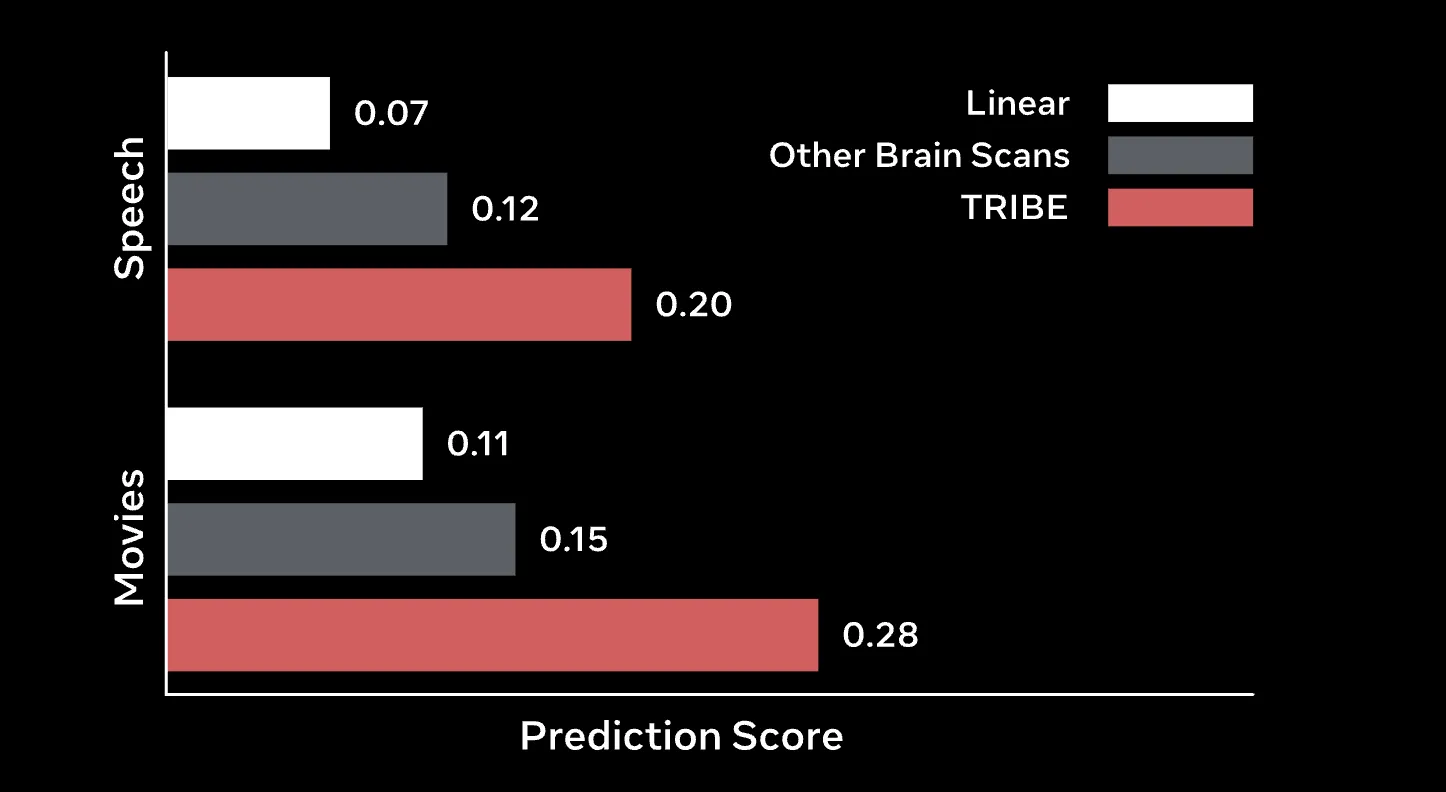
TRIBE v2 significantly outperforms traditional
Finite Impulse Response (FIR)
models, the long-standing gold standard for voxel-wise encoding
.
Zero-Shot and Group Performance
One of the model’s most striking capabilities is
zero-shot generalization
to new subjects. Using an ‘unseen subject’ layer, TRIBE v2 can predict the group-averaged response of a new cohort more accurately than the actual recording of many individual subjects within that cohort. In the high-resolution Human Connectome Project (HCP) 7T dataset, TRIBE v2 achieved a group correlation
near 0.4, a two-fold improvement over the median subject’s group-predictivity.
Fine-Tuning
When given a small amount of data (at most one hour) for a new participant, fine-tuning TRIBE v2 for just one epoch leads to a two- to four-fold improvement over linear models trained from scratch
.
In-Silico Experimentation
The research team argue that TRIBE v2 could be useful for
piloting or pre-screening neuroimaging studies
. By running virtual experiments on the
Individual Brain Charting (IBC)
dataset,
the model recovered classic functional landmarks:
Vision:
It accurately localized the fusiform face area (
FFA
) and parahippocampal place area (
PPA
).
Language:
It successfully recovered the temporo-parietal junction (
TPJ
) for emotional processing and
Broca’s area
for syntax.
Furthermore, applying
Independent Component Analysis (ICA)
to the model’s final layer revealed that TRIBE v2 naturally learns five well-known functional networks: primary auditory, language, motion, default mode, and visual
.
Key Takeaway
A Powerhouse Tri-modal Architecture
: TRIBE v2 is a foundation model that integrates
video, audio, and language
by leveraging state-of-the-art encoders like
LLaMA 3.2
for text,
V-JEPA2
for video, and
Wav2Vec-BERT
for audio.
Log-Linear Scaling Laws
: Much like the Large Language Models we use every day, TRIBE v2 follows a
log-linear scaling law
; its ability to accurately predict brain activity increases steadily as it is fed more fMRI data, with no performance plateau currently in sight.
Superior Zero-Shot Generalization
: The model can predict the brain responses of
unseen subjects
in new experimental conditions without any additional training. Remarkably, its zero-shot predictions are often more accurate at estimating group-averaged brain responses than the recordings of individual human subjects themselves.
The Dawn of In-Silico Neuroscience
: TRIBE v2 enables ‘in-silico’ experimentation, allowing researchers to run virtual neuroscientific tests on a computer. It successfully replicated decades of empirical research by identifying specialized areas like the
fusiform face area (FFA)
and
Broca’s area
purely through digital simulation.
Emergent Biological Interpretability
: Even though it’s a deep learning ‘black box,’ the model’s internal representations naturally organized themselves into five well-known functional networks:
primary auditory, language, motion, default mode, and visual
.
Check out the
Code
,
Weights
and
Demo
.
Also, feel free to follow us on
Twitter
and don’t forget to join our
120k+ ML SubReddit
and Subscribe to
our Newsletter
. Wait! are you on telegram?
now you can join us on telegram as well
.

Michal Sutter
Michal Sutter is a data science professional with a Master of Science in Data Science from the University of Padova. With a solid foundation in statistical analysis, machine learning, and data engineering, Michal excels at transforming complex datasets into actionable insights.
Michal Sutter
Agent-Infra Releases AIO Sandbox: An All-in-One Runtime for AI Agents with Browser, Shell, Shared Filesystem, and MCP
Michal Sutter
Google-Agent vs Googlebot: Google Defines the Technical Boundary Between User Triggered AI Access and Search Crawling Systems Today
Michal Sutter
A Coding Guide to Exploring nanobot’s Full Agent Pipeline, from Wiring Up Tools and Memory to Skills, Subagents, and Cron Scheduling
Michal Sutter
An Implementation of IWE’s Context Bridge as an AI-Powered Knowledge Graph with Agentic RAG, OpenAI Function Calling, and Graph Traversal
Michal Sutter
Tencent AI Open Sources Covo-Audio: A 7B Speech Language Model and Inference Pipeline for Real-Time Audio Conversations and Reasoning
Michal Sutter
A Coding Implementation to Design Self-Evolving Skill Engine with OpenSpace for Skill Learning, Token Efficiency, and Collective Intelligence
Michal Sutter
Luma Labs Launches Uni-1: The Autoregressive Transformer Model that Reasons through Intentions Before Generating Images
Michal Sutter
Meet GitAgent: The Docker for AI Agents that is Finally Solving the Fragmentation between LangChain, AutoGen, and Claude Code
Michal Sutter
A Coding Implementation for Building and Analyzing Crystal Structures Using Pymatgen for Symmetry Analysis, Phase Diagrams, Surface Generation, and Materials Project Integration
Michal Sutter
A Coding Implementation Showcasing ClawTeam’s Multi-Agent Swarm Orchestration with OpenAI Function Calling
Michal Sutter
A Coding Guide to Implement Advanced Differential Equation Solvers, Stochastic Simulations, and Neural Ordinary Differential Equations Using Diffrax and JAX
Michal Sutter
Baidu Qianfan Team Releases Qianfan-OCR: A 4B-Parameter Unified Document Intelligence Model
Michal Sutter
Google AI Releases WAXAL: A Multilingual African Speech Dataset for Training Automatic Speech Recognition and Text-to-Speech Models
Michal Sutter
LangChain Releases Deep Agents: A Structured Runtime for Planning, Memory, and Context Isolation in Multi-Step AI Agents
Michal Sutter
Google DeepMind Introduces Aletheia: The AI Agent Moving from Math Competitions to Fully Autonomous Professional Research Discoveries
Michal Sutter
Google AI Introduces ‘Groundsource’: A New Methodology that Uses Gemini Model to Transform Unstructured Global News into Actionable, Historical Data
Michal Sutter
How to Build a Self-Designing Meta-Agent That Automatically Constructs, Instantiates, and Refines Task-Specific AI Agents
Michal Sutter
A Coding Guide to Build a Complete Single Cell RNA Sequencing Analysis Pipeline Using Scanpy for Clustering Visualization and Cell Type Annotation
Michal Sutter
How to Build Progress Monitoring Using Advanced tqdm for Async, Parallel, Pandas, Logging, and High-Performance Workflows
Michal Sutter
Google Launches TensorFlow 2.21 And LiteRT: Faster GPU Performance, New NPU Acceleration, And Seamless PyTorch Edge Deployment Upgrades
Michal Sutter
OpenAI Introduces Codex Security in Research Preview for Context-Aware Vulnerability Detection, Validation, and Patch Generation Across Codebases
Michal Sutter
A Coding Guide to Build a Scalable End-to-End Machine Learning Data Pipeline Using Daft for High-Performance Structured and Image Data Processing
Michal Sutter
How to Build an EverMem-Style Persistent AI Agent OS with Hierarchical Memory, FAISS Vector Retrieval, SQLite Storage, and Automated Memory Consolidation
Michal Sutter
Meet NullClaw: The 678 KB Zig AI Agent Framework Running on 1 MB RAM and Booting in Two Milliseconds
Michal Sutter
How to Build an Explainable AI Analysis Pipeline Using SHAP-IQ to Understand Feature Importance, Interaction Effects, and Model Decision Breakdown
Michal Sutter
A Complete End-to-End Coding Guide to MLflow Experiment Tracking, Hyperparameter Optimization, Model Evaluation, and Live Model Deployment
Michal Sutter
A Coding Implementation to Build a Hierarchical Planner AI Agent Using Open-Source LLMs with Tool Execution and Structured Multi-Agent Reasoning
Michal Sutter
Microsoft Research Introduces CORPGEN To Manage Multi Horizon Tasks For Autonomous AI Agents Using Hierarchical Planning and Memory
Michal Sutter
Google AI Just Released Nano-Banana 2: The New AI Model Featuring Advanced Subject Consistency and Sub-Second 4K Image Synthesis Performance
Michal Sutter
How to Build an Elastic Vector Database with Consistent Hashing, Sharding, and Live Ring Visualization for RAG Systems
Michal Sutter
Beyond Simple API Requests: How OpenAI’s WebSocket Mode Changes the Game for Low Latency Voice Powered AI Experiences
Michal Sutter
VectifyAI Launches Mafin 2.5 and PageIndex: Achieving 98.7% Financial RAG Accuracy with a New Open-Source Vectorless Tree Indexing.
Michal Sutter
A Coding Guide to Instrumenting, Tracing, and Evaluating LLM Applications Using TruLens and OpenAI Models
Michal Sutter
How to Build Transparent AI Agents: Traceable Decision-Making with Audit Trails and Human Gates
Michal Sutter
[Tutorial] Building a Visual Document Retrieval Pipeline with ColPali and Late Interaction Scoring
Michal Sutter
Google Introduces Jetpack Compose Glimmer: A New Spatial UI Framework Designed Specifically for the Next Generation of AI Glasses
Michal Sutter
Agoda Open Sources APIAgent to Convert Any REST pr GraphQL API into an MCP Server with Zero Code
Michal Sutter
How to Build Human-in-the-Loop Plan-and-Execute AI Agents with Explicit User Approval Using LangGraph and Streamlit
Michal Sutter
Google DeepMind Proposes New Framework for Intelligent AI Delegation to Secure the Emerging Agentic Web for Future Economies
Michal Sutter
Moonshot AI Launches Kimi Claw: Native OpenClaw on with 5,000 Community Skills and 40GB Cloud Storage Now
Michal Sutter
Meet ‘Kani-TTS-2’: A 400M Param Open Source Text-to-Speech Model that Runs in 3GB VRAM with Voice Cloning Support
Michal Sutter
Google AI Introduces the WebMCP to Enable Direct and Structured Website Interactions for New AI Agents
Michal Sutter
[In-Depth Guide] The Complete CTGAN + SDV Pipeline for High-Fidelity Synthetic Data
Michal Sutter
Is This AGI? Google’s Gemini 3 Deep Think Shatters Humanity’s Last Exam And Hits 84.6% On ARC-AGI-2 Performance Today
Michal Sutter
Meet OAT: The New Action Tokenizer Bringing LLM-Style Scaling and Flexible, Anytime Inference to the Robotics World
Michal Sutter
Waymo Introduces the Waymo World Model: A New Frontier Simulator Model for Autonomous Driving and Built on Top of Genie 3
Michal Sutter
Mistral AI Launches Voxtral Transcribe 2: Pairing Batch Diarization And Open Realtime ASR For Multilingual Production Workloads At Scale
Michal Sutter
Google Introduces Agentic Vision in Gemini 3 Flash for Active Image Understanding
Michal Sutter
Google Releases Conductor: a context driven Gemini CLI extension that stores knowledge as Markdown and orchestrates agentic workflows
Michal Sutter
Microsoft Unveils Maia 200, An FP4 and FP8 Optimized AI Inference Accelerator for Azure Datacenters
Michal Sutter
DeepSeek AI Releases DeepSeek-OCR 2 with Causal Visual Flow Encoder for Layout Aware Document Understanding
Michal Sutter
Alibaba Introduces Qwen3-Max-Thinking, a Test Time Scaled Reasoning Model with Native Tool Use Powering Agentic Workloads
Michal Sutter
Tencent Hunyuan Releases HPC-Ops: A High Performance LLM Inference Operator Library
Michal Sutter
DSGym Offers a Reusable Container Based Substrate for Building and Benchmarking Data Science Agents
Michal Sutter
What is Clawdbot? How a Local First Agent Stack Turns Chats into Real Automations
Michal Sutter
GitHub Releases Copilot-SDK to Embed Its Agentic Runtime in Any App
Michal Sutter
Salesforce AI Introduces FOFPred: A Language-Driven Future Optical Flow Prediction Framework that Enables Improved Robot Control and Video Generation
Michal Sutter
Zhipu AI Releases GLM-4.7-Flash: A 30B-A3B MoE Model for Efficient Local Coding and Agents
Michal Sutter
A Coding Guide to Understanding How Retries Trigger Failure Cascades in RPC and Event-Driven Architectures
Michal Sutter
Vercel Releases Agent Skills: A Package Manager For AI Coding Agents With 10 Years of React and Next.js Optimisation Rules
Michal Sutter
Black Forest Labs Releases FLUX.2 [klein]: Compact Flow Models for Interactive Visual Intelligence
Michal Sutter
Meet SETA: Open Source Training Reinforcement Learning Environments for Terminal Agents with 400 Tasks and CAMEL Toolkit
Michal Sutter
A Coding Implementation to Build a Unified Apache Beam Pipeline Demonstrating Batch and Stream Processing with Event-Time Windowing Using DirectRunner
Michal Sutter
Tencent Researchers Release Tencent HY-MT1.5: A New Translation Models Featuring 1.8B and 7B Models Designed for Seamless on-Device and Cloud Deployment
Michal Sutter
How Cloudflare’s tokio-quiche Makes QUIC and HTTP/3 a First Class Citizen in Rust Backends
Michal Sutter
How to Build a Robust Multi-Agent Pipeline Using CAMEL with Planning, Web-Augmented Reasoning, Critique, and Persistent Memory
Michal Sutter
NVIDIA AI Researchers Release NitroGen: An Open Vision Action Foundation Model For Generalist Gaming Agents
Michal Sutter
This AI Paper from Stanford and Harvard Explains Why Most ‘Agentic AI’ Systems Feel Impressive in Demos and then Completely Fall Apart in Real Use
Michal Sutter
Google DeepMind Researchers Release Gemma Scope 2 as a Full Stack Interpretability Suite for Gemma 3 Models
Michal Sutter
How to Build a Fully Autonomous Local Fleet-Maintenance Analysis Agent Using SmolAgents and Qwen Model
Michal Sutter
Mistral AI Releases OCR 3: A Smaller Optical Character Recognition (OCR) Model for Structured Document AI at Scale
Michal Sutter
Nanbeige4-3B-Thinking: How a 23T Token Pipeline Pushes 3B Models Past 30B Class Reasoning
Michal Sutter
The Machine Learning Divide: Marktechpost’s Latest ML Global Impact Report Reveals Geographic Asymmetry Between ML Tool Origins and Research Adoption
Michal Sutter
Google LiteRT NeuroPilot Stack Turns MediaTek Dimensity NPUs into First Class Targets for on Device LLMs
Michal Sutter
From Transformers to Associative Memory, How Titans and MIRAS Rethink Long Context Modeling
Michal Sutter
Google Colab Integrates KaggleHub for One Click Access to Kaggle Datasets, Models and Competitions
Michal Sutter
OpenAGI Foundation Launches Lux: A Foundation Computer Use Model that Tops Online Mind2Web with OSGym At Scale
Michal Sutter
Google DeepMind Researchers Introduce Evo-Memory Benchmark and ReMem Framework for Experience Reuse in LLM Agents
Michal Sutter
Meta AI Researchers Introduce Matrix: A Ray Native a Decentralized Framework for Multi Agent Synthetic Data Generation
Michal Sutter
Black Forest Labs Releases FLUX.2: A 32B Flow Matching Transformer for Production Image Pipelines
Michal Sutter
Agent0: A Fully Autonomous AI Framework that Evolves High-Performing Agents without External Data through Multi-Step Co-Evolution
Michal Sutter
Google DeepMind Introduces Nano Banana Pro: the Gemini 3 Pro Image Model for Text Accurate and Studio Grade Visuals
Michal Sutter
Allen Institute for AI (AI2) Introduces Olmo 3: An Open Source 7B and 32B LLM Family Built on the Dolma 3 and Dolci Stack
Michal Sutter
vLLM vs TensorRT-LLM vs HF TGI vs LMDeploy, A Deep Technical Comparison for Production LLM Inference
Michal Sutter
OpenAI Debuts GPT-5.1-Codex-Max, a Long-Horizon Agentic Coding Model With Compaction for Multi-Window Workflows
Michal Sutter
Google Antigravity Makes the IDE a Control Plane for Agentic Coding
Michal Sutter
xAI’s Grok 4.1 Pushes Toward Higher Emotional Intelligence, Lower Hallucinations and Tighter Safety Controls
Michal Sutter
Google DeepMind’s WeatherNext 2 Uses Functional Generative Networks For 8x Faster Probabilistic Weather Forecasts
Michal Sutter
Comparing the Top 4 Agentic AI Browsers in 2025: Atlas vs Copilot Mode vs Dia vs Comet
Michal Sutter
OpenAI Researchers Train Weight Sparse Transformers to Expose Interpretable Circuits
Michal Sutter
Comparing the Top 6 Agent-Native Rails for the Agentic Internet: MCP, A2A, AP2, ACP, x402, and Kite
Michal Sutter
OpenAI Introduces GPT-5.1: Combining Adaptive Reasoning, Account Level Personalization, And Updated Safety Metrics In The GPT-5 Stack
Michal Sutter
Meta AI Releases Omnilingual ASR: A Suite of Open-Source Multilingual Speech Recognition Models for 1600+ Languages
Michal Sutter
Moonshot AI Releases Kosong: The LLM Abstraction Layer that Powers Kimi CLI
Michal Sutter
Comparing Memory Systems for LLM Agents: Vector, Graph, and Event Logs
Michal Sutter
Meet Kosmos: An AI Scientist that Automates Data-Driven Discovery
Michal Sutter
Anthropic Turns MCP Agents Into Code First Systems With ‘Code Execution With MCP’ Approach
Michal Sutter
Why Spatial Supersensing is Emerging as the Core Capability for Multimodal AI Systems?
Michal Sutter
Comparing the Top 6 Inference Runtimes for LLM Serving in 2025
Michal Sutter
OpenAI Introduces IndQA: A Culture Aware Benchmark For Indian Languages
Michal Sutter
Comparing the Top 7 Large Language Models LLMs/Systems for Coding in 2025
Michal Sutter
Anyscale and NovaSky Team Releases SkyRL tx v0.1.0: Bringing Tinker Compatible Reinforcement Learning RL Engine To Local GPU Clusters
Michal Sutter
LongCat-Flash-Omni: A SOTA Open-Source Omni-Modal Model with 560B Parameters with 27B activated, Excelling at Real-Time Audio-Visual Interaction
Michal Sutter
Comparing the Top 6 OCR (Optical Character Recognition) Models/Systems in 2025
Michal Sutter
Anthropic’s New Research Shows Claude can Detect Injected Concepts, but only in Controlled Layers
Michal Sutter
OpenAI Releases Research Preview of ‘gpt-oss-safeguard’: Two Open-Weight Reasoning Models for Safety Classification Tasks
Michal Sutter
Microsoft Releases Agent Lightning: A New AI Framework that Enables Reinforcement Learning (RL)-based Training of LLMs for Any AI Agent
Michal Sutter
MiniMax Releases MiniMax M2: A Mini Open Model Built for Max Coding and Agentic Workflows at 8% Claude Sonnet Price and ~2x Faster
Michal Sutter
Google vs OpenAI vs Anthropic: The Agentic AI Arms Race Breakdown
Michal Sutter
Liquid AI’s LFM2-VL-3B Brings a 3B Parameter Vision Language Model (VLM) to Edge-Class Devices
Michal Sutter
UltraCUA: A Foundation Computer-Use Agents Model that Bridges the Gap between General-Purpose GUI Agents and Specialized API-based Agents
Michal Sutter
Anthrogen Introduces Odyssey: A 102B Parameter Protein Language Model that Replaces Attention with Consensus and Trains with Discrete Diffusion
Michal Sutter
OpenAI Introduces ChatGPT Atlas: A Chromium-based browser with a built-in AI agent
Michal Sutter
Google AI Research Releases DeepSomatic: A New AI Model that Identifies Cancer Cell Genetic Variants
Michal Sutter
Weak-for-Strong (W4S): A Novel Reinforcement Learning Algorithm that Trains a weak Meta Agent to Design Agentic Workflows with Stronger LLMs
Michal Sutter
Kong Releases Volcano: A TypeScript, MCP-native SDK for Building Production Ready AI Agents with LLM Reasoning and Real-World actions
Michal Sutter
Google AI Releases C2S-Scale 27B Model that Translate Complex Single-Cell Gene Expression Data into ‘cell sentences’ that LLMs can Understand
Michal Sutter
7 LLM Generation Parameters—What They Do and How to Tune Them?
Michal Sutter
Meta’s ARE + Gaia2 Set a New Bar for AI Agent Evaluation under Asynchronous, Event-Driven Conditions
Michal Sutter
Microsoft AI Debuts MAI-Image-1: An In-House Text-to-Image Model that Enters LMArena’s Top-10
Michal Sutter
Google Open-Sources an MCP Server for the Google Ads API, Bringing LLM-Native Access to Ads Data
Michal Sutter
What are ‘Computer-Use Agents’? From Web to OS—A Technical Explainer
Michal Sutter
RA3: Mid-Training with Temporal Action Abstractions for Faster Reinforcement Learning (RL) Post-Training in Code LLMs
Michal Sutter
Model Context Protocol (MCP) vs Function Calling vs OpenAPI Tools — When to Use Each?
Michal Sutter
Google AI Introduces Gemini 2.5 ‘Computer Use’ (Preview): A Browser-Control Model to Power AI Agents to Interact with User Interfaces
Michal Sutter
OpenAI Debuts Agent Builder and AgentKit: A Visual-First Stack for Building, Deploying, and Evaluating AI Agents
Michal Sutter
StreamTensor: A PyTorch-to-Accelerator Compiler that Streams LLM Intermediates Across FPGA Dataflows
Michal Sutter
How to Evaluate Voice Agents in 2025: Beyond Automatic Speech Recognition (ASR) and Word Error Rate (WER) to Task Success, Barge-In, and Hallucination-Under-Noise
Michal Sutter
This AI Paper Proposes a Novel Dual-Branch Encoder-Decoder Architecture for Unsupervised Speech Enhancement (SE)
Michal Sutter
Neuphonic Open-Sources NeuTTS Air: A 748M-Parameter On-Device Speech Language Model with Instant Voice Cloning
Michal Sutter
Thinking Machines Launches Tinker: A Low-Level Training API that Abstracts Distributed LLM Fine-Tuning without Hiding the Knobs
Michal Sutter
MLPerf Inference v5.1 (2025): Results Explained for GPUs, CPUs, and AI Accelerators
Michal Sutter
The Role of Model Context Protocol (MCP) in Generative AI Security and Red Teaming
Michal Sutter
OpenAI Launches Sora 2 and a Consent-Gated Sora iOS App
Michal Sutter
Delinea Released an MCP Server to Put Guardrails Around AI Agents Credential Access
Michal Sutter
Anthropic Launches Claude Sonnet 4.5 with New Coding and Agentic State-of-the-Art Results
Michal Sutter
Top 10 Local LLMs (2025): Context Windows, VRAM Targets, and Licenses Compared
Michal Sutter
The Latest Gemini 2.5 Flash-Lite Preview is Now the Fastest Proprietary Model (External Tests) and 50% Fewer Output Tokens
Michal Sutter
Google AI Ships a Model Context Protocol (MCP) Server for Data Commons, Giving AI Agents First-Class Access to Public Stats
Michal Sutter
OpenAI Releases ChatGPT ‘Pulse’: Proactive, Personalized Daily Briefings for Pro Users
Michal Sutter
OpenAI Introduces GDPval: A New Evaluation Suite that Measures AI on Real-World Economically Valuable Tasks
Michal Sutter
Vision-RAG vs Text-RAG: A Technical Comparison for Enterprise Search
Michal Sutter
Microsoft Brings MCP to Azure Logic Apps (Standard) in Public Preview, Turning Connectors into Agent Tools
Michal Sutter
Top 15 Model Context Protocol (MCP) Servers for Frontend Developers (2025)
Michal Sutter
LLM-as-a-Judge: Where Do Its Signals Break, When Do They Hold, and What Should “Evaluation” Mean?
Michal Sutter
An Internet of AI Agents? Coral Protocol Introduces Coral v1: An MCP-Native Runtime and Registry for Cross-Framework AI Agents
Michal Sutter
Xiaomi Released MiMo-Audio, a 7B Speech Language Model Trained on 100M+ Hours with High-Fidelity Discrete Tokens
Michal Sutter
Google’s Sensible Agent Reframes Augmented Reality (AR) Assistance as a Coupled “what+how” Decision—So What does that Change?
Michal Sutter
Top Computer Vision CV Blogs & News Websites (2025)
Michal Sutter
Physical AI: Bridging Robotics, Material Science, and Artificial Intelligence for Next-Gen Embodied Systems
Michal Sutter
MIT’s LEGO: A Compiler for AI Chips that Auto-Generates Fast, Efficient Spatial Accelerators
Michal Sutter
Meta AI Researchers Release MapAnything: An End-to-End Transformer Architecture that Directly Regresses Factored, Metric 3D Scene Geometry
Michal Sutter
Ai2 Researchers are Changing the Benchmarking Game by Introducing Fluid Benchmarking that Enhances Evaluation along Several Dimensions
Michal Sutter
Google AI Ships TimesFM-2.5: Smaller, Longer-Context Foundation Model That Now Leads GIFT-Eval (Zero-Shot Forecasting)
Michal Sutter
Stanford Researchers Introduced MedAgentBench: A Real-World Benchmark for Healthcare AI Agents
Michal Sutter
OpenAI Introduces GPT-5-Codex: An Advanced Version of GPT-5 Further Optimized for Agentic Coding in Codex
Michal Sutter
Software Frameworks Optimized for GPUs in AI: CUDA, ROCm, Triton, TensorRT—Compiler Paths and Performance Implications
Michal Sutter
Top 12 Robotics AI Blogs/NewsWebsites 2025
Michal Sutter
Deepdub Introduces Lightning 2.5: A Real-Time AI Voice Model With 2.8x Throughput Gains for Scalable AI Agents and Enterprise AI
Michal Sutter
TwinMind Introduces Ear-3 Model: A New Voice AI Model that Sets New Industry Records in Accuracy, Speaker Labeling, Languages and Price
Michal Sutter
What are Optical Character Recognition (OCR) Models? Top Open-Source OCR Models
Michal Sutter
OpenAI Adds Full MCP Tool Support in ChatGPT Developer Mode: Enabling Write Actions, Workflow Automation, and Enterprise Integrations
Michal Sutter
Top 7 Model Context Protocol (MCP) Servers for Vibe Coding
Michal Sutter
ParaThinker: Scaling LLM Test-Time Compute with Native Parallel Thinking to Overcome Tunnel Vision in Sequential Reasoning
Michal Sutter
A New MIT Study Shows Reinforcement Learning Minimizes Catastrophic Forgetting Compared to Supervised Fine-Tuning
Michal Sutter
Alibaba AI Unveils Qwen3-Max Preview: A Trillion-Parameter Qwen Model with Super Fast Speed and Quality
Michal Sutter
Meet Chatterbox Multilingual: An Open-Source Zero-Shot Text To Speech (TTS) Multilingual Model with Emotion Control and Watermarking
Michal Sutter
Biomni-R0: New Agentic LLMs Trained End-to-End with Multi-Turn Reinforcement Learning for Expert-Level Intelligence in Biomedical Research
Michal Sutter
AI and the Brain: How DINOv3 Models Reveal Insights into Human Visual Processing
Michal Sutter
15 Most Relevant Operating Principles for Enterprise AI (2025)
Michal Sutter
What is AI Agent Observability? Top 7 Best Practices for Reliable AI
Michal Sutter
Chunking vs. Tokenization: Key Differences in AI Text Processing
Michal Sutter
Accenture Research Introduce MCP-Bench: A Large-Scale Benchmark that Evaluates LLM Agents in Complex Real-World Tasks via MCP Servers
Michal Sutter
Top 20 Voice AI Blogs and News Websites 2025: The Ultimate Resource Guide
Michal Sutter
The State of Voice AI in 2025: Trends, Breakthroughs, and Market Leaders
Michal Sutter
OpenAI Releases an Advanced Speech-to-Speech Model and New Realtime API Capabilities including MCP Server Support, Image Input, and SIP Phone Calling Support
Michal Sutter
Australia’s Large Language Model Landscape: Technical Assessment
Michal Sutter
What is Agentic RAG? Use Cases and Top Agentic RAG Tools (2025)
Michal Sutter
The Evolution of AI Protocols: Why Model Context Protocol (MCP) Could Become the New HTTP for AI
Michal Sutter
Google AI’s New Regression Language Model (RLM) Framework Enables LLMs to Predict Industrial System Performance Directly from Raw Text Data
Michal Sutter
What is MLSecOps(Secure CI/CD for Machine Learning)?: Top MLSecOps Tools (2025)
Michal Sutter
Your LLM is 5x Slower Than It Should Be. The Reason? Pessimism—and Stanford Researchers Just Showed How to Fix It
Michal Sutter
How Do GPUs and TPUs Differ in Training Large Transformer Models? Top GPUs and TPUs with Benchmark
Michal Sutter
What is a Database? Modern Database Types, Examples, and Applications (2025)
Michal Sutter
What is a Voice Agent in AI? Top 9 Voice Agent Platforms to Know (2025)
Michal Sutter
Large Language Models LLMs vs. Small Language Models SLMs for Financial Institutions: A 2025 Practical Enterprise AI Guide
Michal Sutter
Native RAG vs. Agentic RAG: Which Approach Advances Enterprise AI Decision-Making?
Michal Sutter
Top 10 AI Blogs and News Websites for AI Developers and Engineers in 2025
Michal Sutter
What Is Speaker Diarization? A 2025 Technical Guide: Top 9 Speaker Diarization Libraries and APIs in 2025
Michal Sutter
What is DeepSeek-V3.1 and Why is Everyone Talking About It?
Michal Sutter
Meet South Korea’s LLM Powerhouses: HyperClova, AX, Solar Pro, and More
Michal Sutter
Migrating to Model Context Protocol (MCP): An Adapter-First Playbook
Michal Sutter
Hello, AI Formulas: Why =COPILOT() Is the Biggest Excel Upgrade in Years
Michal Sutter
Emerging Trends in AI Cybersecurity Defense: What’s Shaping 2025? Top AI Security Tools
Michal Sutter
BlackRock Introduces AlphaAgents: Advancing Equity Portfolio Construction with Multi-Agent LLM Collaboration
Michal Sutter
Master Vibe Coding: Pros, Cons, and Best Practices for Data Engineers
Michal Sutter
Is Model Context Protocol MCP the Missing Standard in AI Infrastructure?
Michal Sutter
What is AI Inference? A Technical Deep Dive and Top 9 AI Inference Providers (2025 Edition)
Michal Sutter
Hugging Face Unveils AI Sheets: A Free, Open-Source No-Code Toolkit for LLM-Powered Datasets
Michal Sutter
What Is AI Red Teaming? Top 18 AI Red Teaming Tools (2025)
Michal Sutter
From Deployment to Scale: 11 Foundational Enterprise AI Concepts for Modern Businesses
Michal Sutter
Meet dots.ocr: A New 1.7B Vision-Language Model that Achieves SOTA Performance on Multilingual Document Parsing
Michal Sutter
Amazon Unveils Bedrock AgentCore Gateway: Redefining Enterprise AI Agent Tool Integration
Michal Sutter
Top 6 Model Context Protocol (MCP) News Blogs (2025 Update)
Michal Sutter
Top 12 API Testing Tools For 2025
Michal Sutter
Top 10 AI Agent and Agentic AI News Blogs (2025 Update)
Michal Sutter
Why Docker Matters for Artificial Intelligence AI Stack: Reproducibility, Portability, and Environment Parity
Michal Sutter
Mistral AI Unveils Mistral Medium 3.1: Enhancing AI with Superior Performance and Usability
Michal Sutter
Case Studies: Real-World Applications of Context Engineering
Michal Sutter
NVIDIA AI Introduces End-to-End AI Stack, Cosmos Physical AI Models and New Omniverse Libraries for Advanced Robotics
Michal Sutter
The Best Chinese Open Agentic/Reasoning Models (2025): Expanded Review, Comparative Insights & Use Cases
Michal Sutter
From 100,000 to Under 500 Labels: How Google AI Cuts LLM Training Data by Orders of Magnitude
Michal Sutter
9 Agentic AI Workflow Patterns Transforming AI Agents in 2025
Michal Sutter
FAQs: Everything You Need to Know About AI Agents in 2025
Michal Sutter
Technical Deep Dive: Automating LLM Agent Mastery for Any MCP Server with MCP- RL and ART
Michal Sutter
Alibaba Qwen Unveils Qwen3-4B-Instruct-2507 and Qwen3-4B-Thinking-2507: Refreshing the Importance of Small Language Models
Michal Sutter
Proxy Servers Explained: Types, Use Cases & Trends in 2025 [Technical Deep Dive]
Michal Sutter
NVIDIA XGBoost 3.0: Training Terabyte-Scale Datasets with Grace Hopper Superchip
Michal Sutter
MoE Architecture Comparison: Qwen3 30B-A3B vs. GPT-OSS 20B
Michal Sutter
Google DeepMind Introduces Genie 3: A General Purpose World Model that can Generate an Unprecedented Diversity of Interactive Environments
Michal Sutter
Model Context Protocol (MCP) FAQs: Everything You Need to Know in 2025
Michal Sutter
Now It’s Claude’s World: How Anthropic Overtook OpenAI in the Enterprise AI Race
Michal Sutter
7 Essential Layers for Building Real-World AI Agents in 2025: A Comprehensive Framework
Michal Sutter
A Technical Roadmap to Context Engineering in LLMs: Mechanisms, Benchmarks, and Open Challenges
Michal Sutter
The Ultimate Guide to CPUs, GPUs, NPUs, and TPUs for AI/ML: Performance, Use Cases, and Key Differences
Michal Sutter
Falcon LLM Team Releases Falcon-H1 Technical Report: A Hybrid Attention–SSM Model That Rivals 70B LLMs
Michal Sutter
The Ultimate 2025 Guide to Coding LLM Benchmarks and Performance Metrics
Michal Sutter
Next-Gen Privacy: How AI Is Transforming Secure Browsing and VPN Technologies (2025 Data-Driven Deep Dive)
Michal Sutter
Is Vibe Coding Safe for Startups? A Technical Risk Audit Based on Real-World Use Cases
Michal Sutter
9 Open Source Cursor Alternatives You Should Use in 2025
Michal Sutter
Microsoft Edge Launches Copilot Mode to Redefine Web Browsing for the AI Era
Michal Sutter
Key Factors That Drive Successful MCP Implementation and Adoption
Michal Sutter
How Memory Transforms AI Agents: Insights and Leading Solutions in 2025
Michal Sutter
NVIDIA AI Releases GraspGen: A Diffusion-Based Framework for 6-DOF Grasping in Robotics
Michal Sutter
Google DeepMind Introduces Aeneas: AI-Powered Contextualization and Restoration of Ancient Latin Inscriptions
Michal Sutter
GitHub Introduces Vibe Coding with Spark: Revolutionizing Intelligent App Development in a Flash
Michal Sutter
Google Researchers Introduced LSM-2 with Adaptive and Inherited Masking (AIM): Enabling Direct Learning from Incomplete Wearable Data
Michal Sutter
7 MCP Server Best Practices for Scalable AI Integrations in 2025
Michal Sutter
AI Guardrails and Trustworthy LLM Evaluation: Building Responsible AI Systems
Michal Sutter
Top 15+ Most Affordable Proxy Providers 2025
Michal Sutter
The Ultimate Guide to Vibe Coding: Benefits, Tools, and Future Trends
Michal Sutter
Model Context Protocol (MCP) for Enterprises: Secure Integration with AWS, Azure, and Google Cloud- 2025 Update
Michal Sutter
Maybe Physics-Based AI Is the Right Approach: Revisiting the Foundations of Intelligence
Michal Sutter
The Definitive Guide to AI Agents: Architectures, Frameworks, and Real-World Applications (2025)
Michal Sutter
OpenAI Introduces ChatGPT Agent: From Research to Real-World Automation
Michal Sutter
How to Connect Google Colab with Google Drive (2025 Detailed & Updated Guide)
Michal Sutter
50+ Model Context Protocol (MCP) Servers Worth Exploring


