
 五度妙笔
五度妙笔 企业透视镜
企业透视镜 API商城
API商城
 数据库
数据库Google AI Introduces Gemini Embedding 2: A Multimodal Embedding Model that Lets Your Bring Text, Images, Video, Audio, and Docs into the Embedding Space
Google expanded its Gemini model family with the release of
Gemini Embedding 2
. This second-generation model succeeds the text-only
gemini-embedding-001
and is designed specifically to address the high-dimensional storage and cross-modal retrieval challenges faced by AI developers building production-grade
Retrieval-Augmented Generation (RAG)
systems. The
Gemini Embedding 2
release marks a significant technical shift in how embedding models are architected, moving away from modality-specific pipelines toward a unified, natively multimodal latent space.
Native Multimodality and Interleaved Inputs
The primary architectural advancement in Gemini Embedding 2 is its ability to map
five
distinct media types—
Text, Image, Video, Audio, and PDF
—into a single, high-dimensional vector space. This eliminates the need for complex pipelines that previously required separate models for different data types, such as CLIP for images and BERT-based models for text.
The model supports
interleaved inputs
, allowing developers to combine different modalities in a single embedding request. This is particularly relevant for use cases where text alone does not provide sufficient context.
The technical limits for these inputs are defined as:
Text:
Up to 8,192 tokens per request.
Images:
Up to 6 images (PNG, JPEG, WebP, HEIC/HEIF).
Video:
Up to 120 seconds of video (MP4, MOV, etc.).
Audio:
Up to 80 seconds of native audio (MP3, WAV, etc.) without requiring a separate transcription step.
Documents:
Up to 6 pages of PDF files.
By processing these inputs natively, Gemini Embedding 2 captures the semantic relationships between a visual frame in a video and the spoken dialogue in an audio track, projecting them as a single vector that can be compared against text queries using standard distance metrics like
Cosine Similarity
.
Efficiency via Matryoshka Representation Learning (MRL)
Storage and compute costs are often the primary bottlenecks in large-scale vector search. To mitigate this, Gemini Embedding 2 implements
Matryoshka Representation Learning (MRL)
.
Standard embedding models distribute semantic information evenly across all dimensions. If a developer truncates a 3,072-dimension vector to 768 dimensions, the accuracy typically collapses because the information is lost. In contrast, Gemini Embedding 2 is trained to pack the most critical semantic information into the earliest dimensions of the vector.
The model defaults to
3,072 dimensions
, but
Google team has optimized three specific tiers for production use:
3,072:
Maximum precision for complex legal, medical, or technical datasets.
1,536:
A balance of performance and storage efficiency.
768:
Optimized for low-latency retrieval and reduced memory footprint.
Matryoshka Representation Learning
(MRL) enables a ‘short-listing’ architecture. A system can perform a coarse, high-speed search across millions of items using the 768-dimension sub-vectors, then perform a precise re-ranking of the top results using the full 3,072-dimension embeddings. This reduces the computational overhead of the initial retrieval stage without sacrificing the final accuracy of the RAG pipeline.
Benchmarking: MTEB and Long-Context Retrieval
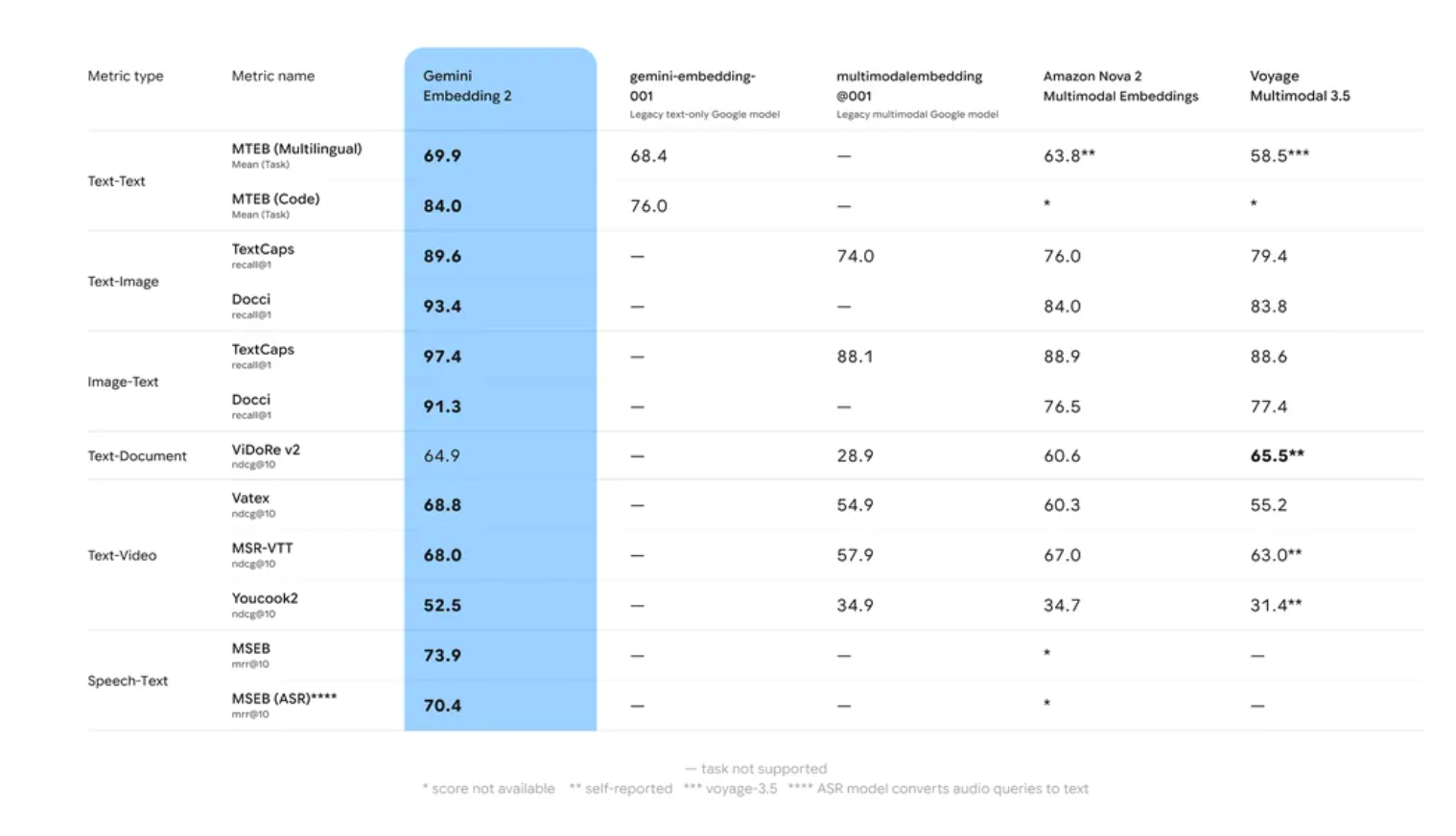
Google AI’s internal evaluation and performance on the
Massive Text Embedding Benchmark (MTEB)
indicate that Gemini Embedding 2 outperforms its predecessor in
two specific areas
:
Retrieval Accuracy
and
Robustness to Domain Shift
.
Many embedding models suffer from ‘domain drift,’ where accuracy drops when moving from generic training data (like Wikipedia) to specialized domains (like proprietary codebases). Gemini Embedding 2 utilized a multi-stage training process involving diverse datasets to ensure higher zero-shot performance across specialized tasks.
The model’s
8,192-token window
is a critical specification for RAG. It allows for the embedding of larger ‘chunks’ of text, which preserves the context necessary for resolving coreferences and long-range dependencies within a document. This reduces the likelihood of ‘context fragmentation,’ a common issue where a retrieved chunk lacks the information needed for the LLM to generate a coherent answer.
Key Takeaways
Native Multimodality
: Gemini Embedding 2 supports five distinct media types—
Text, Image, Video, Audio, and PDF
—within a unified vector space. This allows for
interleaved inputs
(e.g., an image combined with a text caption) to be processed as a single embedding without separate model pipelines.
Matryoshka Representation Learning (MRL)
: The model is architected to store the most critical semantic information in the early dimensions of a vector. While it defaults to
3,072 dimensions
, it supports efficient truncation to
1,536
or
768
dimensions with minimal loss in accuracy, reducing storage costs and increasing retrieval speed.
Expanded Context and Performance
: The model features an
8,192-token input window
, allowing for larger text ‘chunks’ in RAG pipelines. It shows significant performance improvements on the
Massive Text Embedding Benchmark (MTEB)
, specifically in retrieval accuracy and handling specialized domains like code or technical documentation.
Task-Specific Optimization
: Developers can use
task_type
parameters (such as
RETRIEVAL_QUERY
,
RETRIEVAL_DOCUMENT
, or
CLASSIFICATION
) to provide hints to the model. This optimizes the vector’s mathematical properties for the specific operation, improving the “hit rate” in semantic search.
Check out
Technical details
, in Public Preview via the
Gemini API
and
Vertex AI
.
Also, feel free to follow us on
Twitter
and don’t forget to join our
120k+ ML SubReddit
and Subscribe to
our Newsletter
. Wait! are you on telegram?
now you can join us on telegram as well.


