
 五度妙笔
五度妙笔 企业透视镜
企业透视镜 API商城
API商城
 数据库
数据库AI-Native Firms Lead In Revenue Per Employee
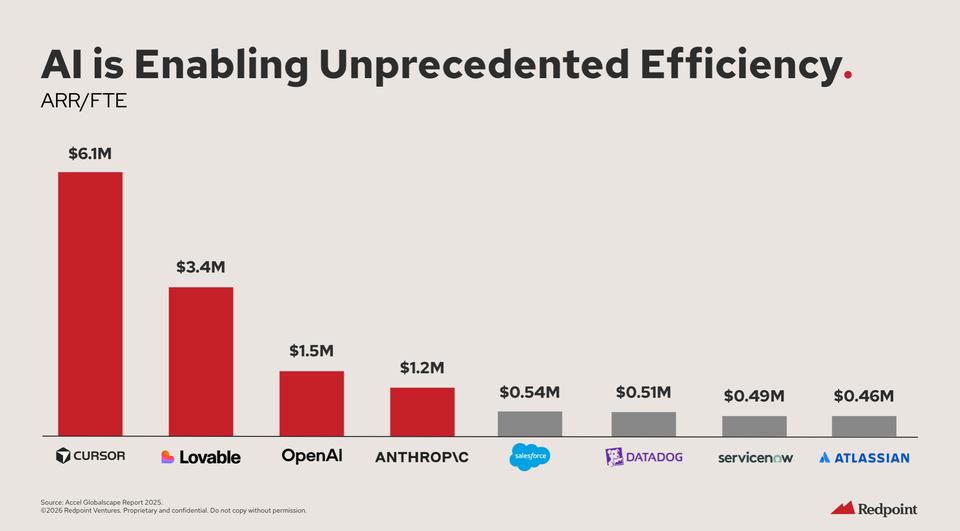
AI software startups have higher revenue per employee (or annual recurring revenue per full time equivalent) than established software companies
Redpoint Ventures
By Paul Baier
AI-native startups generate $2 million to $4 million in revenue per employee. The average public SaaS company generates $300,000. This gap reveals the productivity advantage available to companies willing to redesign how they work.
New startups build every process around AI from day one. They carry no legacy IT systems, no decades-old compensation structures, no political resistance to change. Established companies face all of these obstacles when they try to retrofit AI into existing operations.
I argued in a
previous Forbes column
that revenue per employee is the best north star metric for enterprise AI investment. The performance of AI-native firms makes the case even stronger.
The Productivity Gap in Numbers
Consider Lovable, the Stockholm-based AI coding platform (covered in Forbes
here
). The company reached $400 million in annual recurring revenue in early 2026 with 146 full-time employees, according to TechCrunch. That translates to $2.7 million in ARR per employee and this number has increased.
Midjourney, the AI image-generation company, generates roughly $200 million in annual revenue with approximately 11 employees, roughly $18 million per employee.
CB Insights data shows the top 20 AI agent startups averaging revenue-per-employee ratios that exceed Microsoft ($1.8 million) and Meta ($2.2 million).
Gartner predicts a new wave of unicorns by 2030 generating $2 million in ARR per employee.
In a recent
Redpoint research report
, they highlighted the differences in revenue or Annual Recurring Revenue (ARR) per employee of AI native software firms and established ones.
AI software startups have much hire revenue per employee than established software companies
Redpoint Ventures
These companies achieve this efficiency through product-led growth, AI-automated customer service, AI-driven lead generation, and digital products that require no sales team to distribute. Lovable adds roughly 1,500 paying customers per day with no traditional sales organization.
Recommendations for Established Firms
Build executive fluency in AI.
Require every board member and C-suite executive to log at least 50 hours of personal AI use with one of the 3 major chatbots (ChatGPT, Claude or Gemini). Supplement this with live demonstrations from AI champions or outside consultants showing what previously took 50 hours of work completed in five minutes. Leaders who have not used AI tools themselves do not understand the scale of change ahead. Board and executives teams need to first viscerally understand the power of AI before finding alignment on the correct AI investment level for 2026 and 2027.
Set a three-year north star metric.
Dedicate at least one hour at your next board meeting to define a three-year target for AI and digital investment. Most companies stall because they face 100+ AI use cases with no overarching investment thesis tied to their business strategy. Revenue per employee (or EBITDA per employee for certain industries) provides the unifying financial metric your organization needs.
Benchmark against AI-native firms.
Study the specific processes AI-native companies like Lovable use to drive growth. Yes, a digital product with credit card checkout and a booming market help. But these companies also run world-class AI implementations for software development, lead generation, customer onboarding, and customer service. Your team should identify which of these processes you can replicate or adapt.
The revenue-per-employee gap between AI-forward startups and established firms will widen every quarter. Boards and executive teams that treat this metric as a priority, and act on it now, will close the gap. Those that do not will fall further behind competitors who already have.
FAQ
Question: Why are AI-native companies generating significantly more revenue per employee than traditional firms?
Answer:
AI-native companies design every process around automation from the start, including software development, sales, customer service, and product delivery. This allows them to operate with smaller teams while scaling revenue quickly. Traditional firms often layer AI onto existing systems, which limits the efficiency gains.
Question: What is the most practical way for an established company to close the revenue-per-employee gap?
Answer:
Focus on redesigning high-impact workflows like lead generation, onboarding, and support using AI. Instead of trying to change everything at once, target a few areas where automation can reduce manual work and increase output, then expand based on results.
Question: How should executive teams measure whether their AI investments are actually improving business performance?
Answer:
Set a clear financial target such as revenue per employee or EBITDA per employee and track it consistently. Tie AI initiatives directly to this metric, run short pilots, and scale only the efforts that show measurable improvement.
Editorial Standards
Reprints & Permissions


