
 五度妙笔
五度妙笔 企业透视镜
企业透视镜 API商城
API商城
 数据库
数据库Can Machines Be Creative? One Compelling Answer
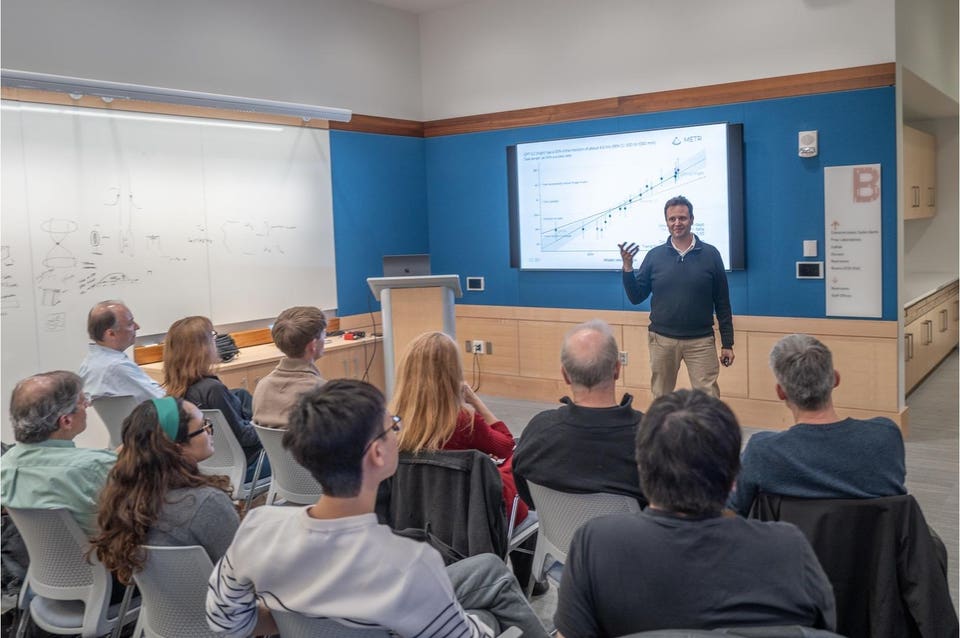
Professor Markus Buehler Presenting on this topic
John Werner
Many people who have been watching the evolution of LLMs over the past two years can tell that we’re on the cusp of moving to a whole new model, away from earlier types of neural nets that can outperform humans at recalling facts, to models that can imagine, transform, and react vibrantly to the physical world. That’s convenient for the roboticists who want to embed these systems in humanoid, bipedal bodies, but it’s also going to require a vast re-ordering of how the world works, on so many levels.
Markus Buehler is doing some very interesting work around this. As a McAfee Professor of Engineering at MIT and Co-Founder & CTO of Unreasonable Labs, Buehler is in a unique place to see how the next generation of AI will likely develop. He recently presented at MIT, prior to a panel discussion on the idea of whether and how machines can do creative work or participate in creative processes. His basic theory is that swarms of nano-agents or other cooperative entities work on a kind of similar basis to human-to-human coordination.
Moving Beyond
Presenting on the idea of “fire to fusion,” Buehler noted how we’re about to change the ways that we look at technology.
“The bar is really, really high,” he said, again invoking the advent of a new kind of neural net. I’ve heard about this before, not least when I stood on the stage at Davos with Yann LeCun and he explained that tomorrow’s AI will not be confined to question -answering machines. So I was ready for this idea. But as ready as you are, it’s still, well, kind of mind-boggling, and to me, it always comes back to philosophy. Let me explain.
Presenting
John Werner
Science is Not Memory
What Buehler brought forth, in large part, was a comparison, or set of comparisons, between human and non-human thinking, contemplating our sense of creativity or world-initiative in a cognitive universe.
The new AI, he suggested, will be “not just a parrot,” but collaborative systems able to think scientifically, to probe the physical world and come up with new ideas and discoveries.
Delineating an “arrow of playback,” an “arrow of generation,” and an “arrow of discovery,” Buehler used METR charts and other resources to show how AI is adapting to achieve these types of capabilities. Playback or replay systems, he explained, are fixed-output, supervised models, the early stage of AI, such as a music box. Generative models “traverse a learned space,” for example, a score. The discovery is where agent swarms “write their own scores,” or solve problems, instead of just navigating a fixed space.
The Creative Human
Here’s Buehler’s working definition of creativity:
“Novelty lived in time, by a system that cannot fully precompute its own becoming, and is changed by what it puts forth.”
Swarms, he contends, are good candidates for this.
“They do really interesting things and solve tough problems if you let them interact,” he said. “It’s not how smart the models are, it’s how they interact with each other. This is very true for humans as well. It’s not the agent, it’s the swarm.”
Going back to the environmental aspect of this, he contrasted two key paths with pictures of a pond and a river: the pond stands for “fishing for known truths,” the river for “actually creating new worlds.”
“We are perhaps crossing the threshold – we’re no longer just creating a big encyclopedia,” Buehler said.
The Philosophy of AI
That covered, Buehler defined a “spark” as a “boundary condition between the known and the undiscovered, the moment potentiality becomes actual.”
“A swarm will believe something about the world, and it will see that it’s not true, and it will change,” he said. “The hardest version of the question may not be whether machines can be creative, but whether knowing the answer, whichever way it falls, changes what the spark felt like before we asked.”
That’s heady stuff, and when Buehler invokes Pascal, or Turing, on the way to machine cognition, it underscores how we may end up seeing machines as creative, as imaginative, as, in so many ways, just like us.
“Today’s AI systems produce things that function as novelty; he said, “they’re useful, surprisingly verifiable, but whether they are creative, whether there’s a spark in the machine or just the mechanical latent possibility, remains genuinely unresolved.”
He describes the whole of human consciousness this way:
“The pain cuts both ways. If AI could genuinely create, then the thing we thought was uniquely ours is not uniquely ours. But if it can’t, and it’s all just pattern completion, then maybe what we do is, too. We just didn’t have the formal tools to see the mechanism underneath.”
Or, maybe humans really are sentient in a way that machines aren’t.
Anyway, this was a really interesting talk. Let’s plan on figuring out how to interact with AI entities endowed with so much sentient power.
Editorial Standards
Reprints & Permissions


