
 五度妙笔
五度妙笔 企业透视镜
企业透视镜 API商城
API商城
 数据库
数据库Women In AI Leadership Drive 47% Stronger Return And Here Is The Proof
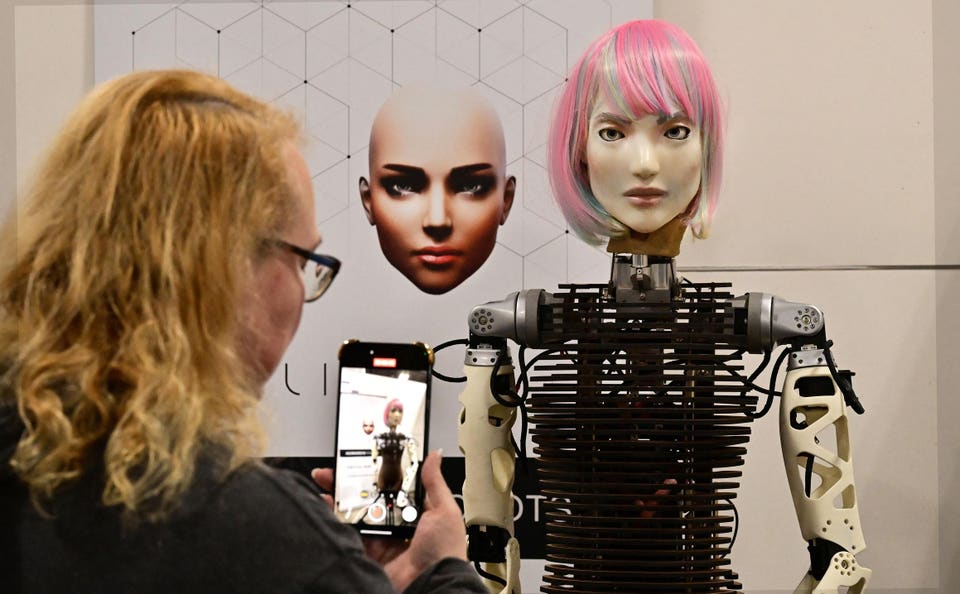
Women in AI Leadership Drive 47% Stronger Returns Here Is the Proof (Photo by Frederic J. BROWN / AFP) (Photo by FREDERIC J. BROWN/AFP via Getty Images)
AFP via Getty Images
I was standing on the Davos stage at the Agentic AI House, in a room packed with some of the most influential technology leaders on the planet. Between sessions, a woman engineer came up to me quietly and said she was the only female on her company's entire AI deployment team. Not the only senior one but the only one. Her company had just announced a $50 million AI investment.
That moment has stayed with me all month, because it is not an outlier. It is a pattern. And as the last day of
International Women's Month
arrives tomorrow, I want to make the case that this pattern is not just a fairness problem. It is a performance problem with a measurable price tag.
AI's Financial Case Is Already Proven
The number every CFO should know is 47. Companies with the highest share of women on executive committees report a 47% higher return on equity than those with no women, according to McKinsey research cited by the
World Economic Forum
. That gap does not live in a corporate report. It lives on the balance sheet.
Now consider where AI is actually being deployed.
Women control an estimated $31.8 trillion in worldwide consumer spending and are projected to command 75% of discretionary spending within five years, according to
NielsenIQ
. Agentic
AI is rolling out across healthcare, retail,
financial services, and education, the exact domains where women are the primary buyers and primary decision-makers.
When the teams building those systems do not reflect the people they serve, the gap shows up in adoption rates, in product quality, and eventually in returns.
Tatyana Kanzaveli, founder of Women in GenAI, is making an impact training women of the AI tools.
Tatyana Kanzaveli
In a chat with Tatyana Kanzaveli, founder of Women in GenAI, she told me, “This reflects a simple truth: the future of AI will be shaped either by a narrow leadership lens or by a broader one. The companies that choose the latter will build smarter systems and stronger businesses.”
Diverse AI Teams See What Homogeneous Ones Miss
The most persistent myth in enterprise AI right now is that underperformance is a technology problem. Deloitte's research tells a different story, finding that 91% of teams reporting the strongest AI outcomes hired for diverse experiences, and that employees who felt their organization overlooked diversity of thought in AI design were 60 percentage points less likely to use AI tools daily.
Low adoption is precisely where AI investments go to die, and it turns out the fix is not a better model. It is a more representative room. Per the Walkme recent 2026 research, they found that 77% of executives say adoption, not tools, is their #1 AI challenge.
“The data is clear: leadership and frontline workers are living in different AI realities. Executives believe the tools are working, yet much of the workforce has never been touched by AI initiatives, and those who have often don’t trust it beyond basic tasks. When decision-makers can’t see what’s happening on the ground, that blind spot compounds. Organizations that bring frontline perspectives into their AI strategy will close these gaps far faster than those planning from the top down. " said KJ Kusch, Field CTO, WalkMe.
The talent pipeline to solve it is already there. In
Information Week
, Ensono's Speak Up Report found that 89% of women in tech agree their generative AI skills have accelerated their careers, and the proportion ranking themselves at expert level doubled year over year.
The Industry Is Starting to Act on Women in AI
The most encouraging signal this month has been watching AI companies move from statements to action on exactly this. Lovable opened its entire platform free for 24 hours on International Women's Day through its SheBuilds initiative, partnering with Anthropic and Stripe to give every participant $350 in combined credits across 30 community events in 17 countries.
Laura Heisman, CMO of Dynatrace, shared this in our recent conversation: "The rise of AI isn't just a call for women to adapt, it's an opportunity for women to lead. Traditional paths are breaking down, opening doors for women to step into emerging opportunities and redefine what's possible. Progress isn't automatic though. Without intentional action, women risk being sidelined in this transformation. When we support women through mentorship, intentional recruiting, and shared learning, we don't just advance opportunity, we build better technology and stronger businesses."
Laura Heisman, CMO of Dynatrace, is a supporter of diversity of thought in AI work.
Dynatrace
Through communities like
Unstoppable Women of AI and Blockchain
, more than 55,000 women across 92 countries have been trained in AI. The consistent finding across every cohort and every geography is that when women are given genuine access and genuine authority in AI work, adoption widens, output improves, and the business results follow. That is the spirit of AI First, Human Always.
Consider Michaela Ternasky-Holland who an Emmy award-winning, Peabody-nominated director, and the first one in the world to premiere a film made with AI at Tribeca Film Festival. She did not wait for access. She built a new creative language with AI and proved what is possible when women lead at the frontier. She is not the exception. She should be the blueprint.
Michaela A. Ternasky-Holland, the first person to release an AI Film at the Tribeca Film festival.
Michaela A. Ternasky-Holland
As this month closes, the question worth asking in every organization is a simple one.
When your AI strategy is being written and your agents are being scoped, who is actually in that room with real authority? The 47% return gap and the Deloitte adoption data both point to the same answer.
Women in AI leadership is not a gesture. It is a growth strategy. And the proof, in 2026, is impossible to ignore in Agentic AI.
Editorial Standards
Reprints & Permissions


