
 五度妙笔
五度妙笔 企业透视镜
企业透视镜 API商城
API商城
 数据库
数据库Panasonic’s AI visual inspection platform goes global–and Singapore built it
Panasonic’s AI visual inspection platform, developed in Singapore, is now available for global licensing across construction, infrastructure and manufacturing
The move marks a strategic shift: Panasonic is repositioning its Singapore R&D centre from an internal lab to a commercial AI licensor
Panasonic’s AI visual inspection platform has been quietly proving itself on the facades of over a thousand buildings across Singapore. Now, Panasonic Holdings is expanding its global presence. The company
announced
on March 13 the global licensing launch of its AI Platform for Visual Inspection, developed by Panasonic R&D Centre Singapore.
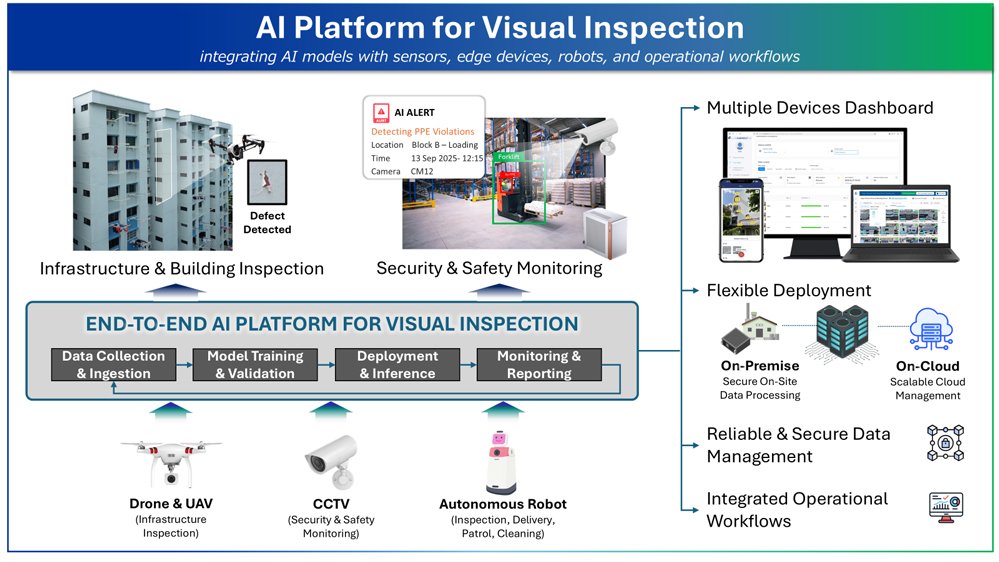
The platform automates defect detection across infrastructure inspection, construction quality checking, factory safety management, and production-line quality control — handling everything from data ingestion and model training through to deployment and ongoing maintenance on a single architecture.
It is also the first time Panasonic has globally licensed technology originating from its Singapore centre–a detail that matters more than it might seem.
From ropeways to the AI visual inspection platform
Building facade inspection in Singapore is not optional. Under the Building Control Act, property owners must conduct periodic facade inspections, a regulation that has historically meant workers dangling from gondola lifts or tethered to ropes on high-rises. Drone technology has been reshaping this for several years, but the bottleneck was never the hardware. It was the analysis.
Panasonic’s platform addresses that gap. The system takes imagery captured by drones, robots, CCTV systems or industrial PCs and runs it through AI models trained to flag defects– cracks, corrosion, delamination–before generating structured inspection reports that comply with regulatory requirements. The workflow cuts reporting lead times and reduces the manual review burden that made drone-based inspection only a partial solution.
NovaPeak Pte. Ltd., a Singapore-based drone services company, has already adopted it for its building facade inspection product,. NovaPeak has used the platform on more than 1,000 buildings in Singapore–a live-deployment record that Panasonic is using as its proof point as it pitches to international partners.
Singapore as Panasonic’s AI export engine
Panasonic R&D Centre Singapore was established in 1990, originally
focused
on AV signal processin
g–T
V image processing
,
display technologies, and
that
era’s priorities
.
The centre has since pivoted toward AI-centred development, and the visual inspection platform is the clearest commercial output of that shift to date.
The global licensing push fits within a broader strategic recalibration at the group level. Panasonic HD launched ‘Panasonic Go’ at CES 2025–a corporate growth initiative anchored on AI-powered, software-led business transformation. The group has targeted AI-driven hardware, software, and solutions to contribute 30% of total revenue by 2035, and CEO Yuki Kusumi has explicitly framed 2026 as the ‘year to achieve a turnaround to our growth phase.’
What is notable about the visual inspection platform is where it sits in that strategy. This is not a consumer product or an internal tool. It is a B2B AI platform that Panasonic is licensing to third-party operators, a model more associated with software-native companies than with a Japanese electronics conglomerate that built its reputation on hardware. The Singapore centre is, in effect, becoming Panasonic’s AI commercialisation vehicle for the enterprise market.
The Panasonic AI visual inspection platform and the APAC opportunity
The platform’s target sectors, construction, infrastructure, manufacturing, and
smart cities, map closely onto where APAC governments and enterprises are spending on digital transformation. Singapore’s regulatory framework for facade inspection creates a ready-made adoption driver.
Equivalent pressures exist across the region
:
ageing building stock in Japan and South Korea, infrastructure expansion
across
Southeast Asia, and
factory safety compliance requirements in manufacturing-heavy economies.
The architecture of the platform is designed to scale across this diversity. It accepts input from drones, robots, CCTV systems, and industrial PCs within a unified framework, meaning a partner can deploy it on an existing sensor fleet without a full hardware overhaul. The lifecycle management–from proof-of-concept through to commercial deployment–runs on a single platform, which reduces the friction that has historically made enterprise AI adoption expensive to sustain.
Panasonic has indicated it will expand partnerships across industries and regions, though it has not disclosed specific markets or timelines beyond the licensing launch announcement.
A different kind of Panasonic
The visual inspection announcement sits alongside other signals of where Panasonic is heading. The group has deployed its internal AI assistant, PX-AI, to approximately 180,000 employees. Its Blue Yonder subsidiary makes over 20 billion supply chain predictions daily using a combination of predictive and generative AI. It has a global strategic partnership with Anthropic embedded within Panasonic Well, its wellness venture.
None of these is the same business as selling televisions. The visual inspection licensing launch adds another data point to the picture of a company that has been rewriting what it does–quietly, and through its regional R&D centres–while the attention has been on its battery investments and supply chain software.
The question for enterprise buyers in APAC is whether the 1,000-building track record in Singapore translates cleanly to their operating environments. The early evidence, at least, is that Panasonic did not rush this one to market.


