
 五度妙笔
五度妙笔 企业透视镜
企业透视镜 API商城
API商城
 数据库
数据库😺 What does OpenAI see coming
Sign Up
·
Advertise

Welcome, humans.
Netflix and Meta just showed two very different ways AI is getting more useful and more accessible.
Netflix researchers released VOID
, a model that can remove objects from video and realistically fill in what belongs behind them, which could make editing faster, cheaper, and way less painful. They even
open-sourced it on Hugging Face
, so it’s not just a lab demo collecting dust.
Meanwhile, Meta is reportedly planning to
open-source versions of its next AI models
, even as it keeps some of its biggest systems proprietary. That sounds like the new AI compromise: give developers enough to build with,
while keeping the crown jewels in-house
.
Put together, it’s a good snapshot of where AI is headed: more powerful tools are escaping the lab, but companies are getting pickier about
how much
they share.
Open is still in. It just comes with more fine print now.
Video Links
:
Google's Secret Robotics Play That Nobody's Talking About
How to be "Agent Native" in 2026 (w/ Every CEO Dan Shipper)
This AI Agent Just Solved EV's Biggest Problem (SES AI CEO Dr. Qichao Hu)
Here’s what happened in AI today:
Iran threatened OpenAI’s Stargate AI hub in Abu Dhabi
SEO firms race to game AI search results.
OpenAI and Anthropic pushed toward IPOs despite massive AI costs.
Chip packaging became a key battleground in the AI boom.
Xoople raised $130M to map the Earth for AI.
… and a
whole lot more that you can read about here(insert link)
.
P.S:
Want to reach 675,000 AI-hungry readers?
Click here to advertise with us.
P.P.S:
Love robots? We’re starting a new robotics newsletter!
Sign up early here
.

😺
OpenAI just published a mini-New Deal for AI
OpenAI has spent the past few weeks signaling that it thinks the next phase is closer than most people realize. Between its leadership reshuffle around AGI deployment and outside reporting on its next frontier model, codenamed “Spud,” Monday’s policy paper felt less like a thought exercise and more like a flare gun.
In
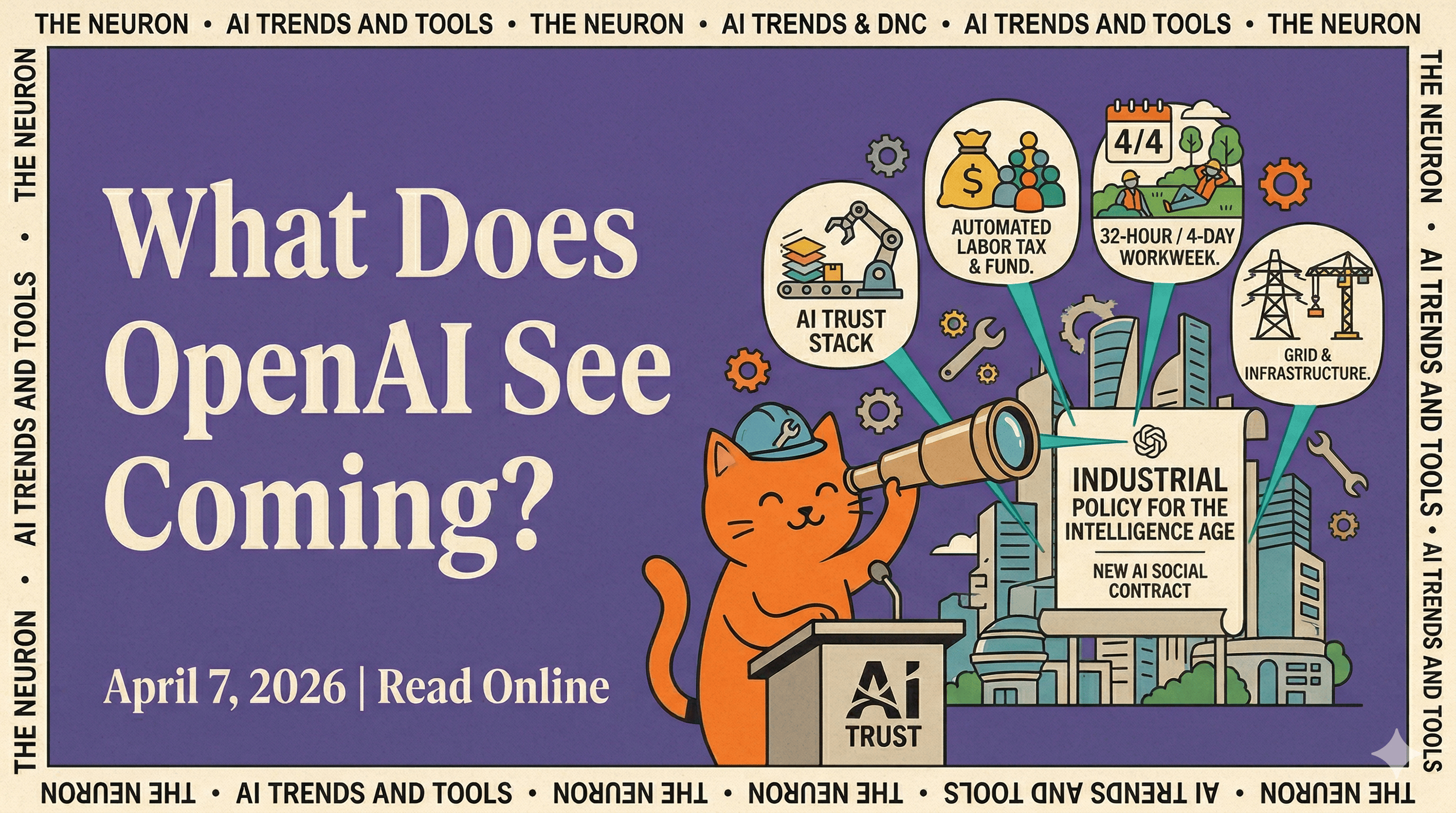
“Industrial Policy for the Intelligence Age”
, OpenAI argues that minor policy tweaks won’t be enough if superintelligence starts hits jobs, taxes, public systems, cyber defense, and biosecurity all at once. The 13-page paper is framed as a conversation starter, not a final blueprint.
The company compares this moment to the Industrial Age, arguing that the Progressive Era and New Deal had to rebuild the social contract for electricity, mass production, and modern industry, and AI may require something similarly ambitious.
A few proposals jumped off the page:
Shift the tax base away from labor
and toward capital, corporate income, and even taxes tied to automated labor, then use tools like
a public wealth fund
so citizens share in AI upside.
Turn productivity into time back
, with pilots for a 32-hour / four-day workweek, plus portable benefits and safety nets that expand automatically when AI disruption crosses pre-set thresholds.
Build more infrastructure and oversight
, from faster grid expansion to an “AI trust stack,” stronger auditing markets, incident reporting, and more public input into how powerful systems are governed.
That’s the real tell here. OpenAI is talking less like a lab asking Washington to be careful. It’s talking like a company that believes AI could move fast enough to strain payroll-tax-funded programs, scramble labor-market norms, and force a rewrite of how the upside gets shared.
That’s a much bigger statement than the internet’s inevitable “robot tax” memes. OpenAI is also trying to move the conversation from PDF to policy, with fellowships, research grants of up to $100,000, as much as $1M in API credits, and a new workshop in Washington, DC.
Early reaction was basically:
whoa
, and
convenient
.
Axios
framed it as a tech titan sketching how government should tax, regulate, and redistribute wealth from the very technology he is building.
Business Insider
zeroed in on the splashiest bits: automated-labor taxes, a public wealth fund, and a four-day week.
The Wall Street Journal
read it as part of OpenAI’s broader push to shape the coming AI policy fight.
And yes, the skepticism is earned. While positioning OpenAI is obviously one of the goals, that doesn’t make it less important and timely. Someone had to go first, and I prefer science to lead the conversation than partisan politics.
Our take:
If frontier labs are moving from “please don’t slow us down” to “help redesign labor, welfare, infrastructure, and oversight around our models,” then this conversation is no longer theoretical. It’s overdue. We’re glad to see someone step to the table for a conversation and hope others will, as well. This is a time for solutions, not partisan or competitive bickering.Main story here.

FROM OUR PARTNERS
The Neuron Exclusive: You Could Be an Investor in High-Potential AI Startups Like These
The Neuron and Alumni Ventures are teaming up this week to give readers early
access to high-growth startup opportunities
, including some of today’s most exciting AI, Deep Tech, Quantum Computing, and Cybersecurity companies co-invested alongside top VC firms like Andreessen Horowitz (a16z), Bessemer, & Y Combinator.
You get:
Curated deal flow of high-potential AI Firststartups
AV is already investing alongside elite lead venture firms in these deals
No cost to see deals
No obligation to invest
Don’t miss your chance before access closes.
→
Join Alumni Ventures AI First Syndicate Today

🎓
One underrated Microsoft Copilot trick: turn a good AI answer into a working doc.
Instead of copying a Copilot response into Word, fixing the formatting, then losing it in tab purgatory, you can hit
Edit in Pages
and turn that response into a persistent, editable page. Then Copilot stays beside it, so you can keep saying things like “shorten this,” “turn this into a project brief,” or “add a launch checklist,” and it updates the page as you go.
Copilot Pages
is available for Microsoft 365 Personal, Family, and Premium subscribers, plus many work / school users with OneDrive or SharePoint. So yes, your chatbot blob can finally evolve into an actual draft.
Revolutionary stuff for Copilot users currently living in Copy / Paste / Regret.
Total AI beginner?
Start here
(
goes with this video
).
Have a specific skill you want to learn?
Request it here.

Trending: Three popular Neuron podcast eps…
New episodes air
every week
on:
Spotify
|
Apple Podcasts
|
YouTube
 |
 |
 |

🍪 Treats to Try
*Asterisk = from our partners (only the first one!).
Advertise to 675K+ readers here
!
SentrySearch
lets you type something like “red truck running a stop sign” and instantly pull the exact moment from hours of MP4 footage, then export the clip without sending your video to the cloud. Free to try.
Rectify
gives you one place to watch your OpenClaw agents in a live 3D office, assign work on Kanban boards, and run the rest of your ops stack without bouncing between tools. No pricing details.
Singify
turns a song you love into a new voice cover in a few clicks. Free to try.
AutoClaw
sets up your OpenClaw assistant in one click so you can hand it real tasks and let it use real tools right inside chat. No pricing details
Gerri
reviews your contracts against your playbook, handles routine redlines automatically, and sends anything unusual to the right teammate so deals keep moving.

📰 Around the Horn
Iran threatened to “
completely and utterly annihilate
” OpenAI’s Stargate AI data center in Abu Dhabi as regional tensions escalated.
The
AI search boom
created a new arms race as SEO firms and brands tried to manipulate search to get cited by ChatGPT, Gemini, and Google’s AI tools.
The WSJ reported that
OpenAI and Anthropic
were racing toward IPOs even as both companies faced huge AI training costs and continued heavy cash burn.
WIRED reported that
advanced chip packaging emerged
as a major AI bottleneck, with Intel saying the business could bring in more than $1 billion and possibly land Google and Amazon deals.
Spain’s
Xoople raised a $130 million
Series B to build a satellite data business designed to generate better Earth data for AI models.
Want absolutely EVERYTHING that happened in AI this week? Click here(Link)!

📖
Tuesday Tool-Tip
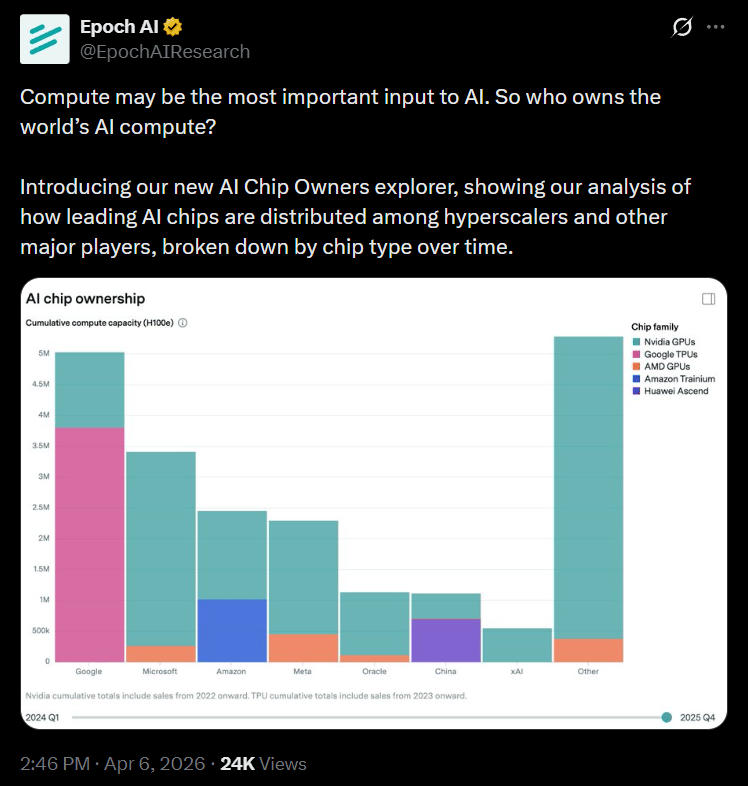
Epoch’s new
AI Chip Owners explorer
answers a very 2026 question:
who actually owns the brains behind the AI boom?
And, surprise, the chart mostly reads like
“Nvidia, Nvidia, Nvidia… with a few guest appearances.”
Google’s TPU stack looks impressive, sure—but Nvidia still shows up like the landlord of AI compute, collecting rent from basically everyone building anything serious. At this point, calling it a “market share” almost feels too polite—it’s more like the rest of the industry is fighting over the armrests while Nvidia owns the whole couch.

A Cat’s Commentary
 |
|
P.S:
Before you go… have you subscribed to our YouTube Channel? If not, can you?

Click the image to subscribe!
P.P.S:
Love the newsletter, but only want to get it once per week? Don’t unsubscribe—
update your preferences here
.


