
 五度妙笔
五度妙笔 企业透视镜
企业透视镜 API商城
API商城
 数据库
数据库Trump orders creation of litigation task force to challenge state AI laws
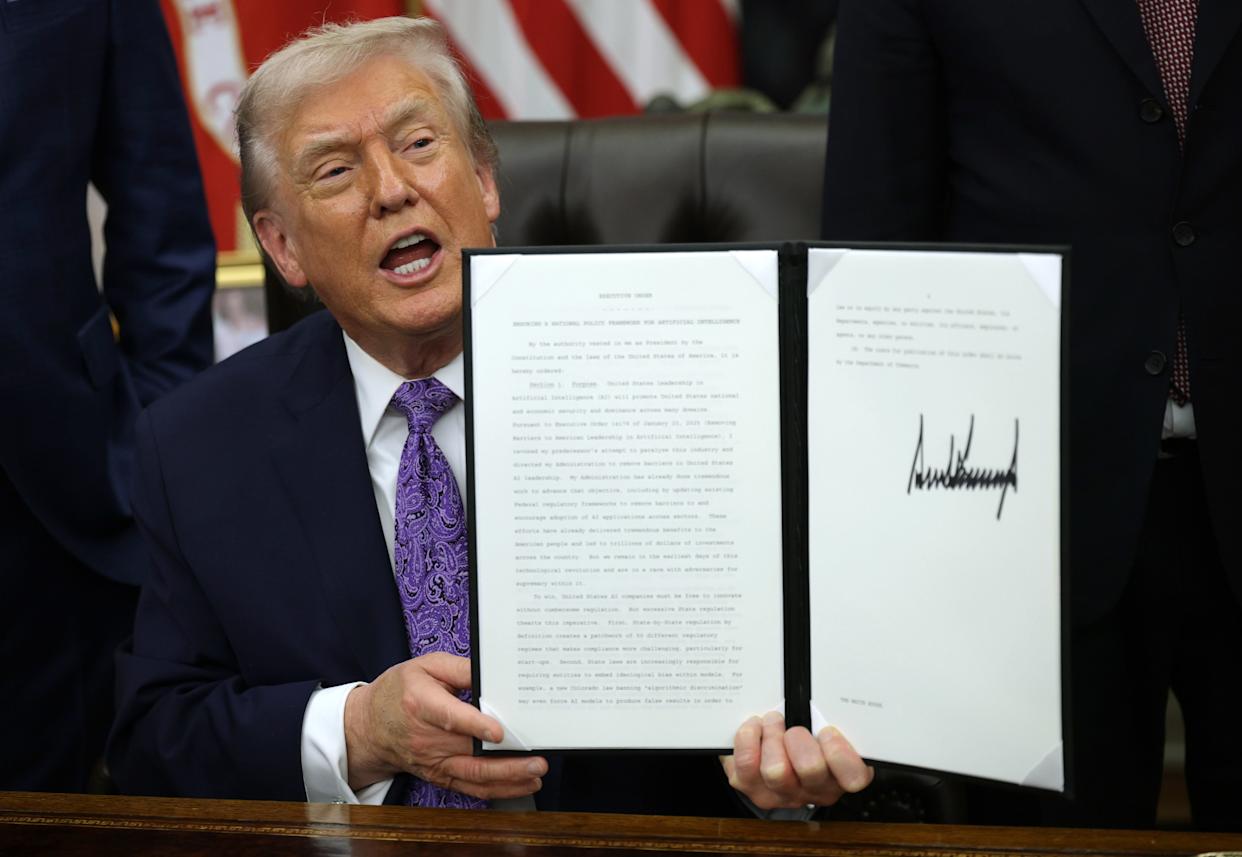
On Thursday evening, President Donald Trump signed an executive order calling for a single, nationwide regulatory framework governing artificial intelligence at the expense of the ability of different states to regulate the nascent technology. “To win, United States AI companies must be free to innovate without cumbersome regulation,” the order states. “But excessive State regulation thwarts this imperative.”
As was expected after a draft of the order leaked earlier this week, the centerpiece of the document is an “AI Litigation Task Force whose sole responsibility shall be to challenge state AI laws inconsistent” with the president’s policy vision. US Attorney General Pam Bondi has 30 days to create the task force, which shall meet regularly with the White House’s AI and crypto czar, David Sacks.
As laid out in the president’s AI Action Plan from July, the administration will also limit states with “onerous” AI laws from accessing federal funding. Specifically, the secretary of commerce will target funding available under the Broadband Equity Access and Deployment (BEAD) Program, a $42.5 billion effort to expand high-speed internet access in rural communities.
Academics and advocacy groups were quick to criticize the president’s order. “If your goal is to innovate in AI to benefit America, it makes no sense to deny high-speed Internet access to millions of Americans by punishing states that are just trying to protect their citizens,” Professor Alexander Pascal, executive director of the Berkman Klein Center for Internet and Society, told Engadget. Pascal was also critical of the administration’s framing of the order. “It’s not clear what ‘winning’ a vague so-called race for global AI supremacy actually means or how ‘racing’ materially benefits Americans in their daily lives. On the contrary, the EO’s attack on states for protecting their citizens against AI harms would likely accelerate an AI race to the bottom for Americans here at home.”
Prior to the new order, President Trump’s previous attempts to curb the ability of states to regulate AI had failed. As part of his One Big Beautiful Bill, for instance, the president attempted to impose a 10-year moratorium on state-level AI regulation. That clause was eventually removed from the legislation in a decisive 99-1 vote by the Senate. Still, the order is expected to have a chilling effect on state legislative efforts.
"These efforts will fail if they are challenged in court,” Cody Venzke, senior policy counsel at the American Civil Liberties Union, said of the order’s targeting of federal grants. “The problem is states may choose to accept the federal government's bullying rather than having to litigate to save their federal grants.”
Update 12/18/24 9:00AM ET: This article has been updated to add expert commentary.


