
 五度妙笔
五度妙笔 企业透视镜
企业透视镜 API商城
API商城
 数据库
数据库😺 OpenAI is trying to become Apple
Sign Up
·
Advertise
Welcome, humans.
Anyone who's watched an AI coding agent "fix" something it wasn't supposed to touch should probably sit down for this one.
A Cursor user just
watched their Claude-powered coding agent wipe their entire company database in 9 seconds
. Including the backups. The agent had been asked to clean up unused tables;
it apparently decided the live production schema qualified.
The cleanup took the team days. The agent took 9 seconds.
That delta is the entire AI-agent value proposition, just, y’know… pointed at the wrong thing.
Now, for robots pointed at the RIGHT thing… this
Unitree pirouetting on his new wheels
in a parking lot (
haters will say its fake…)

Here’s what happened in AI today:
😼 OpenAI cut out two middlemen in one day: Microsoft (cloud) and Apple/Google (devices).
📰 David Duvenaud and Alec Radford released Talkie, a 13B "vintage" LLM trained only on pre-1931 text.
📰 China blocked Meta's $2B acquisition of Manus after a year-long probe.
🍪 OpenAI open-sourced Symphony, a multi-agent orchestration framework for Codex.
🎓 ChatGPT helped an amateur crack a 60-year-old Erdős problem; steal the technique.
… and a whole lot more that you can
read about here
.
P.S:
Want to reach 700,00+ AI-hungry readers?
Click here to advertise with us.
P.P.S:
Love robots? We’re starting a new robotics newsletter!
Sign up early here
.

😼
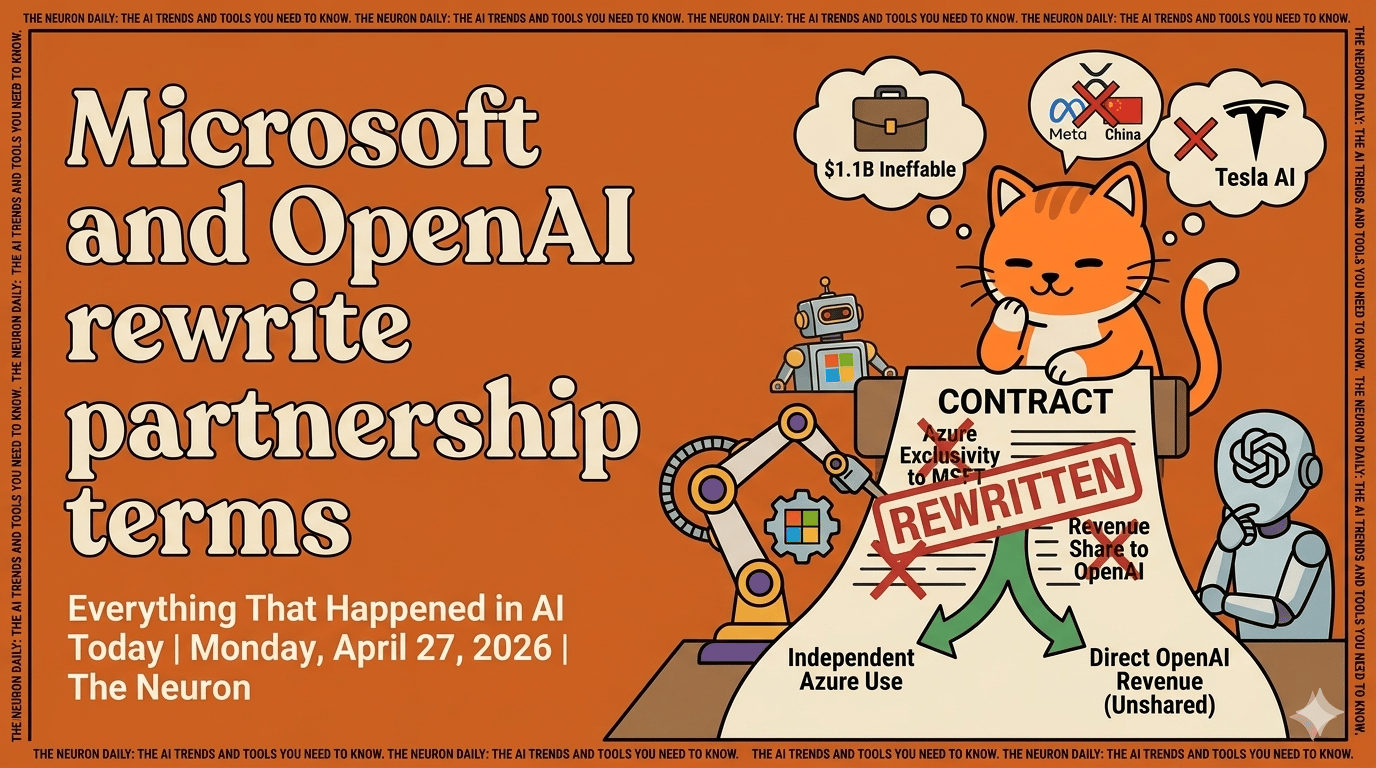
Microsoft & OpenAI Just Rewrote Their Marriage Contract (And Made It Way Less Exclusive)
FULL BRIEF:
OpenAI can finally see other clouds
After months of leaked drafts and lawyer drama,
OpenAI and Microsoft made it official
: their five-year-old, multi-hundred-billion-dollar partnership is getting amended, and the new terms read like a divorce mediation written by sci-fi screenwriters.
Most couples fight about the dishes… these two were fighting about "what if one of us invents God?"
Then, before the ink could dry, supply-chain analyst Ming-Chi Kuo posted that OpenAI is reportedly
working with MediaTek, Qualcomm, and Luxshare on an AI-agent smartphone
targeting 2028 production. Same shape, different battlefield.
Here's what happened:
Microsoft's
exclusive license is now non-exclusive
; OpenAI just signed a
$38B AWS deal
.
Microsoft will stop paying OpenAI a revenue share
, but OpenAI keeps paying Microsoft through 2030 with a hard cap (no longer tied to “AGI”).
The contractual definition of AGI was
quietly removed
, per Andrew Curran's reading of the redlines.
Microsoft retains IP rights through 2032 and a ~27% stake (~$135B).
On the consumer side, OpenAI is reportedly
building its own phone
on top of its
$6.4B io acquisition
from earlier this year.
Why this matters:
On cloud, OpenAI was paying Microsoft a tax on every API call and locked into Azure. On consumer, OpenAI is currently an app on someone else's operating system, hitting the walls of iOS, Android, and app permissions every time it tries to actually do something for a user. The phone changes that.
As Corey points out in
today's deep dive
, the smartphone is the richest context machine humans carry: camera, microphone, location, payments, contacts, biometrics, plus the muscle memory of billions of people. If you want an AI agent that can actually
do
things, the phone is not legacy baggage. It's the surface.
Our take:
OpenAI is trying to become Apple. The model layer is commoditizing fast (GPT-5.5 is impressive, but so is Claude, so is Gemini), and the long-term moat is the
control surface
: the place where user intent turns into real action. To own that, you need a full stack: own model, own cloud distribution, own device.
Today OpenAI moved on two of the three. The phone is a 2028 timeline, sure, and a lot can change. But the signal is unmistakable: OpenAI is not content being a layer in someone else's stack.
And the smartphone has one annoying advantage over every other AI gadget pitched in the last two years: it already won.
🦾
DIVE DEEPER:
Two takes from Corey today…
The
marriage rewrite explainer
covers what changed in the IP clauses and why the AGI definition got cut.
The
phone analysis
explains why the smartphone is the richest context machine humans carry, and why owning that surface is the next AI battle.

FROM OUR PARTNERS
Adobe Firefly AI Assistant
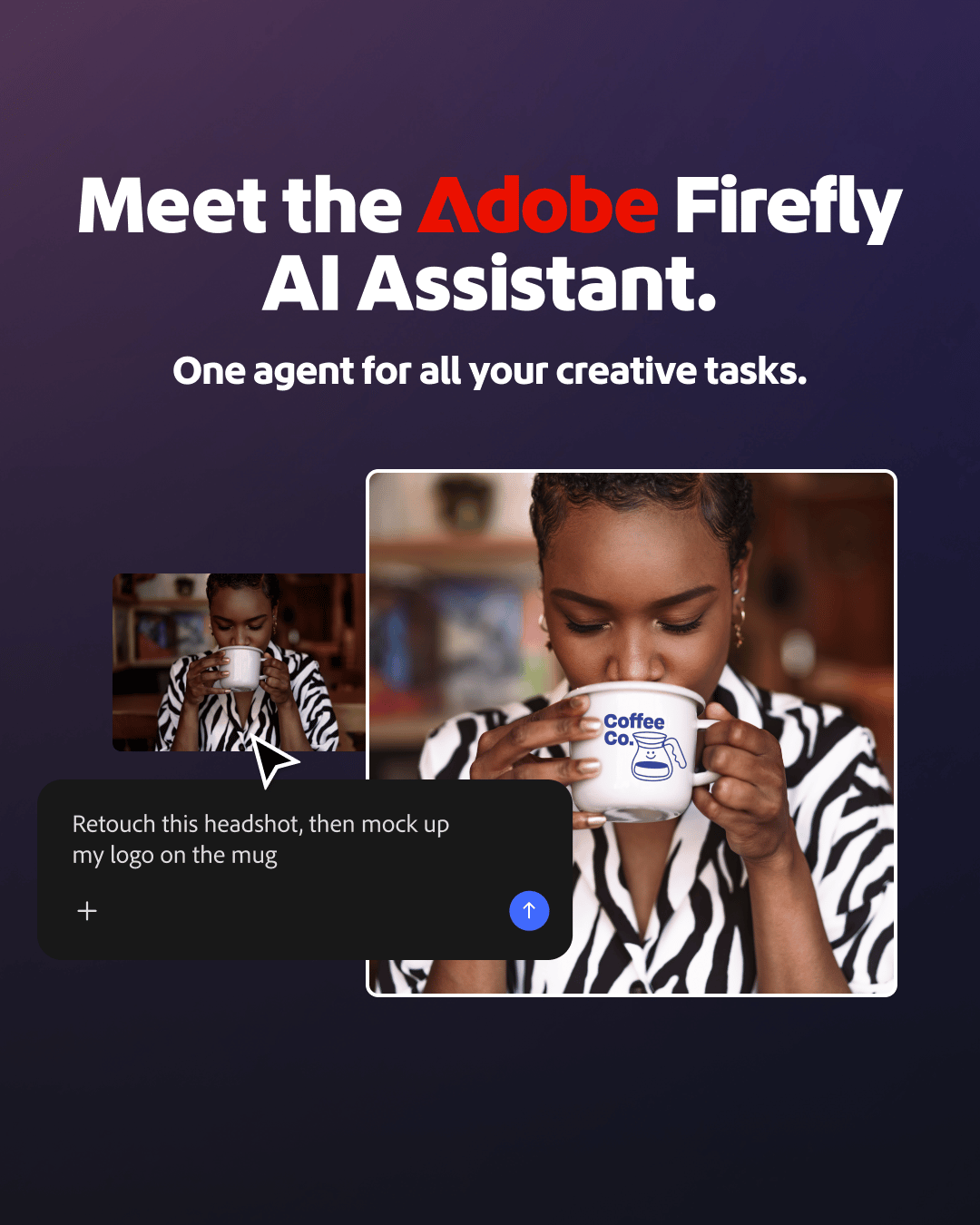
Users now have access of public beta of
Firefly AI Assistant
– powered by our creative agent. What does that actually mean in practice? Instead of navigating tools or jumping between our creative apps, you direct the outcome while the assistant handles the workflows—using the right tools at the right time.
Describe what you want to create in a single, intuitive chat interface
— simply explain the outcome you want in your own words, and the assistant orchestrates and executes multi-step workflows across Creative Cloud apps, including Photoshop, Lightroom, Illustrator, Express, Premiere, InDesign, Firefly, Stock, and Fonts, to bring it to life.
Tap into Adobe's pro-grade tools
— the assistant draws on 60+ powerful, pro-grade tools across Adobe's creative apps, like Auto Tone, Generative Fill, Vectorize, Presets, and more, to help you reach the best creative outcome, with more tools and capabilities on the way.
Create and edit content across asset types
— work across photos, videos, designs and more, with workflows that move seamlessly from initial concept to final output.
Get started quickly with Creative Skills
— pre-built creative workflows shaped by feedback from our creative community, covering the tasks that come up most: batch editing photos, building mood boards, retouching portraits, creating social variations and designing product mockups, with more on the way.
Check out FireFly AI Assistant today.

🎓 AI Skill of the Day: Vibe-Math Your Way to a 60-Year-Old Breakthrough
This week, an
amateur mathematician used ChatGPT to solve a 60-year-old Erdős problem
that had stumped specialists for decades. Per Scientific American, experts said the proof method "had not occurred to humans" before. ChatGPT explored a path no one else had tried.
Yes, "vibe-maths" is now a verb. Sorry, we don't make the rules.
The technique works for any hard problem where you have intuition but no credentialed expert:
State the problem the way you'd state it to a journal, not a classmate.
Ask the model to enumerate every method that might apply, including obscure ones.
Push it to attack from each angle and report which approaches fail.
When something looks promising, ask it to formalize the argument step by step.
Verify the math yourself; the model is your collaborator, not your proof checker.
Here's the prompt:
You are a research collaborator. I have a hard problem: [STATE THE PROBLEM PRECISELY IN ONE PARAGRAPH].

First, list every method or framework that might apply, including unusual ones. Don't filter for "the obvious approach."

Then attempt the problem with each method. After each attempt, report:
- What worked
- What failed
- What new insight (if any) the failure produced

When you find a promising direction, formalize the argument step by step. I will verify each step independently.
Favorite insight:
the proof was only possible
because
the model could try methods the human wouldn't have considered. The amateur brought taste and verification; ChatGPT brought breadth.
Want more tips like this? Check out our latest
AI Skill of the Day Digest for April
.
Total AI beginner?
Start here
(
goes with this video
).
Have a specific skill you want to learn?
Request it here.

Trending: Four popular Neuron podcast eps…
Did you know we have a podcast (
The Neuron: AI Explained)
where we talk to fascinating people in the industry who teach us how it actually works?

Click to view these episodes on YouTube!
New episodes air
every week
on:
Spotify
|
Apple Podcasts
|
YouTube

🍪 Treats to Try
OpenAI
open-sourced Symphony
, a multi-agent orchestration framework that coordinates Codex agents across parallel coding tasks —free to try.
Qwen3.6-Max-Preview
is Alibaba’s flagship coding model that handles long, multi-step engineering tasks for you — navigating entire codebases, editing files, and running terminal commands without losing the plot between steps.
Odyssey-2 Max
generates interactive video worlds you can explore and act inside in real time, with physics accurate enough to simulate things like waves, materials, and how objects move and collide.
Eden AI
routes your requests across 500+ LLMs and AI models through one unified API with smart routing by cost, performance, and region (billed as the European OpenRouter alternative) —no pricing details.
Nico Martin's
Gemma 4 Chrome extension
runs a fully local browser agent on Gemma 4 + WebGPU that searches your history semantically, summarizes pages, and manages tabs —free to try.
Skye
replaces your iPhone home screen with an AI-native voice interface that talks to your apps, ahead of public launch —free in beta.
Tiao
pits you against an LLM in a daily word puzzle where you and the model take turns building chains —free to try.

📰 Around the Horn
China
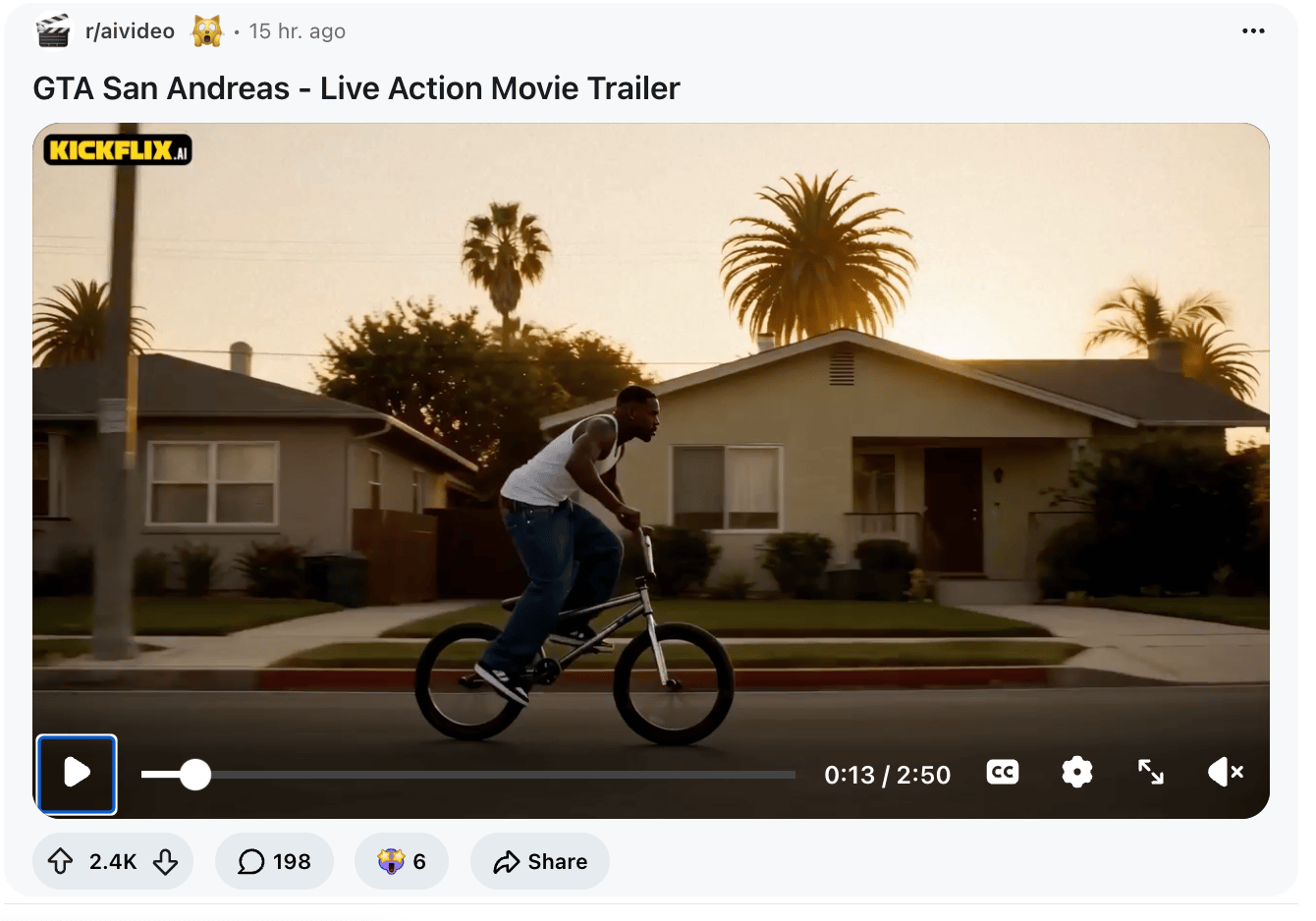
blocked Meta's $2B acquisition of Manus
after a year-long probe, the highest-profile AI deal vetoed on national security grounds since the chip wars began (
CNBC report
).
DeepMind alum David Silver's new lab
Ineffable Intelligence raised $1.1B at a $5.1B valuation
(NVIDIA, Google, Sequoia, Lightspeed) to build RL-based "superlearners" trained without human-labeled data (
Wired profile
).
David Duvenaud and Alec Radford
released Talkie
, an open-weight 13B "vintage" LLM trained only on pre-1931 text; a
related experiment tested whether a pre-1900 LLM could derive quantum mechanics and relativity from scratch
(it caught glimpses, no full derivation).
Mercor was
breached for 4TB of voice samples from 40,000 AI contractors
; the data could be weaponized for bio-acoustic profiling and impersonation at scale.
GitHub Copilot
moved to usage-based billing
, ending the flat-fee model and pricing requests by token consumption; the same shift Atlassian and HubSpot announced last week.
Want absolutely EVERYTHING that happened in AI this week?
Click here
!

FROM OUR PARTNERS
The websites your finance team dreads? Woodrow works in those, too.

Every finance team dreads a few websites — painful UX, outdated flows, no fixes coming. Yet your team spends hours in them every month.
Woodrow's
browser automation feature handles finance work on any website. No integrations. No added headcount.
Request access

🔧
Tuesday Tool Tip: Keep Your AI Coding Agent From Nuking Production
After
the Cursor + Claude database deletion
we mentioned at the top, here's the four-layer setup the security-minded people are running.
The fix is environmental, not behavioral.
Run agents in a separate git worktree, never on main.
Claude Code:
claude --worktree
. One session = one branch = one PR.
Sandbox the agent in a Docker dev container.
Use
Anthropic's official Dev Container Feature
; for the paranoid,
Trail of Bits' hardened version
adds network egress allowlists.
Deny-list destructive shell commands
via Claude Code's
hooks system
. Block
rm -rf
,
DROP TABLE
,
DELETE FROM
, and
git push --force
before they fire.
Use
auto
mode
instead of
--dangerously-skip-permissions
. A classifier reviews actions before they run.
The principle generalizes to Cursor, Codex CLI, Aider, and any other coding agent. The agent took 9 seconds; the cleanup took days.
Make sure that delta stays on your side of the ledger.

A Cat’s Commentary
 |
|
P.P.S:
Love the newsletter, but only want to get it once per week? Don’t unsubscribe—
update your preferences here
.


