
 五度妙笔
五度妙笔 企业透视镜
企业透视镜 API商城
API商城
 数据库
数据库Eleven Music Review: AI Music Without the Legal headaches
The
AI music space
has a new contender.
ElevenLabs
(the company already dominating AI voice and audio) officially launched
Eleven Music
not too long ago, and honestly? It might be the most ambitious AI music platform released to date.
According to ElevenLabs, Eleven Music is designed to be “
the most comprehensive AI audio platform in the world,
” and after digging into everything it offers, that claim is hard to argue with.
What stood out most to me wasn’t just the quality. It secured licensing deals with
Merlin
and
Kobalt
, meaning the music you generate with Eleven Music has a legal foundation. That’s huge.
Meanwhile, competitors like
Suno
and
Udio
are trying to fight off
copyright infringement claims
from some of the biggest music labels.
In this Eleven Music review, I’ll discuss the pros and cons, what it is, who it’s best for, and its key features. Then, I’ll show you how I used Eleven Music to generate a song with lyrics in minutes.
I’ll finish the article by comparing it to my top three alternatives:
Suno
,
Udio
, and
Soundraw
.
Whether you’re a filmmaker hunting for the perfect cinematic score, a podcaster who needs royalty-free background tracks, or a creator who’s tired of paying licensing fees,
Eleven Music
is targeting you. Let’s see if it’s right for you.
Verdict
Eleven Music
generates high-quality audio quickly and offers useful tools like remixing, multilingual support, and commercial licensing. However, the
free plan
may feel restrictive for beginners.
Pros and Cons
High-quality 44.1kHz audio
Realistic vocals and instrumentals
Fast song generation
Royalty-free commercial licensing
Supports multiple languages and remixing
Monetization opportunities through the Marketplace
Mobile app available for iOS
Some vocals sound robotic
AI-generated lyrics can feel generic
The prompt system may be difficult for beginners to learn
The free plan is quite limited (e.g., no downloads or commercial-use generation)
Song generation can take a few minutes for longer/more complex tracks
Not nearly as much control as traditional Digital Audio Workstations (DAW)
What is Eleven Music?
If you’ve been anywhere near the
AI content creation
space in the last couple of years, you already know
ElevenLabs
. They’re the company behind some of the most realistic
AI voice generators
I’ve ever used.
I used its text-to-speech generator
and was blown away by how realistic it sounded.
But ElevenLabs is more than just
AI voice generation
. They built out a whole AI audio ecosystem:
Lifelike voice cloning
Sound effects generation
Dubbing tools
that can translate and lip-sync video in multiple languages
If it involves audio, they’ve been quietly building a tool for it.
Eleven Music
is a newer expansion,
officially launched in August 2025
. It marks ElevenLabs moving beyond voice and into full generative music creation, so it’s a big deal.
What Eleven Music Does
In simple terms, Eleven Music lets you generate studio-level music from
natural language prompts
in any genre, style, and structure. That’s with or without vocals, in multiple languages, in a matter of minutes.
For example, you can type something like “upbeat lo-fi hip hop, no lyrics, good for studying,” and it spits out a track up to five minutes long. Most of the outputs are usable right out of the box.
With
Eleven Music
, you have complete control. The tracks are built for use across film, podcasts, advertising,
social media
, and more.
Eleven Music vs. Suno & Udio
You’ve probably heard of
Suno
and
Udio
(I’ve tried both of them. They’re the other big players in
AI-generated music
right now). They’re also really impressive.
But here’s what sets it apart:
Eleven Music
is cleared for commercial use. That distinguishes it from competitors like Suno and Udio that are currently facing label lawsuits.
In June 2024, Sony, Universal, and Warner sued Suno and Udio for
alleged mass copyright infringement
, seeking up to $150,000 per infringed work. That’s not a small legal risk to ignore if you’re a business.
Meanwhile, ElevenLabs
secured licensing deals
with
Merlin
(a digital rights organization representing many of the world’s top independent record labels) and
Kobalt Music Group
(the biggest independent music publisher worldwide) before launching the product.
That’s not something most AI companies have done, and it means something crucial: the music you generate has a legal foundation.
Eleven Music Accessibility & Integrations
In terms of accessibility,
Eleven Music
is available online through their website and as a
public API
, with billing set at $0.50 per minute of generated audio.
ElevenLabs
also plans to integrate
Eleven Music
into its
Conversational AI platform
. This would eventually bring AI-generated music into
interactive voice experiences
(very exciting!)
Overall, if you’re looking for an AI music tool that can be used in professional work with fewer copyright concerns,
Eleven Music
is the strongest option.
Who is Eleven Music Best For?
Eleven Music
suits creators needing fast, royalty-free music without musical expertise:
YouTubers and marketers
can generate background tracks, introduction music, or video soundscapes in minutes, saving hours on stock music hunts.
Video editors and podcasters can generate cinematic scores or upbeat instrumentals.
Social media marketers can produce brand-aligned jingles in multiple languages to boost global reach and maintain consistency without copyright risks.
Indie musicians and hobbyists can use remix tools and lyric generation to spark creative ideas or
overcome writer’s block
, with the Marketplace providing a platform to earn from shared tracks.
Developers can leverage the API to integrate automated music into games,
mobile apps
, or
creative software tools
.
Advertisers can create custom audio jingles and background scores for campaigns without the high cost of hiring a composer or purchasing expensive licenses.
Artists and producers can rapidly prototype song ideas, test different vocal styles, or experiment with different genres before committing to a full studio recording.
Game developers
can generate adaptive soundscapes and atmospheric background music that fit the gameplay pacing without worrying about traditional copyright hurdles.
Independent filmmakers
can create custom scores for indie projects and trailers on a budget, with music cleared for festival screenings and digital distribution.
Eleven Music Key Features
Eleven Music’s
strengths lie in AI music creation for
creators and businesses
:
Input natural language descriptions like “retro 80s synthwave” to produce studio-level tracks with vocals and instruments, or instrumentals only.
Supports multiple languages, including English, Spanish, German, and Japanese.
Songs are generated in minutes and are ready for commercial use via partnerships with Merlin Network and Kobalt Music Group.
Developers can use the
ElevenLabs API
for programmatic generation, duration (3 seconds to 10 minutes; sections can be 3 seconds to 2 minutes each), and saving MP3 outputs.
Take existing AI-generated songs and remix them to modify the genres, tempos, or styles.
Create an artist profile to publish tracks, build a public presence, and organize your music within the platform.
Write your own lyrics or get AI to generate them for you.
Earn revenue
by
creating or remixing AI-generated tracks and publishing them to the ElevenLabs Music Marketplace.
How to Use Eleven Music
Here’s how I used
Eleven Music
to generate a song and lyrics in minutes:
Create an Eleven Music Account
Explore Music & Artists
View the Library
Create an Artist Profile
Add a Prompt in the Studio
Tweak the Settings
Generate Lyrics
Add Mood, Genre, & Energy
Generate Song & View Lyrics
View Song Menu Options
Step 1: Create an Eleven Music Account
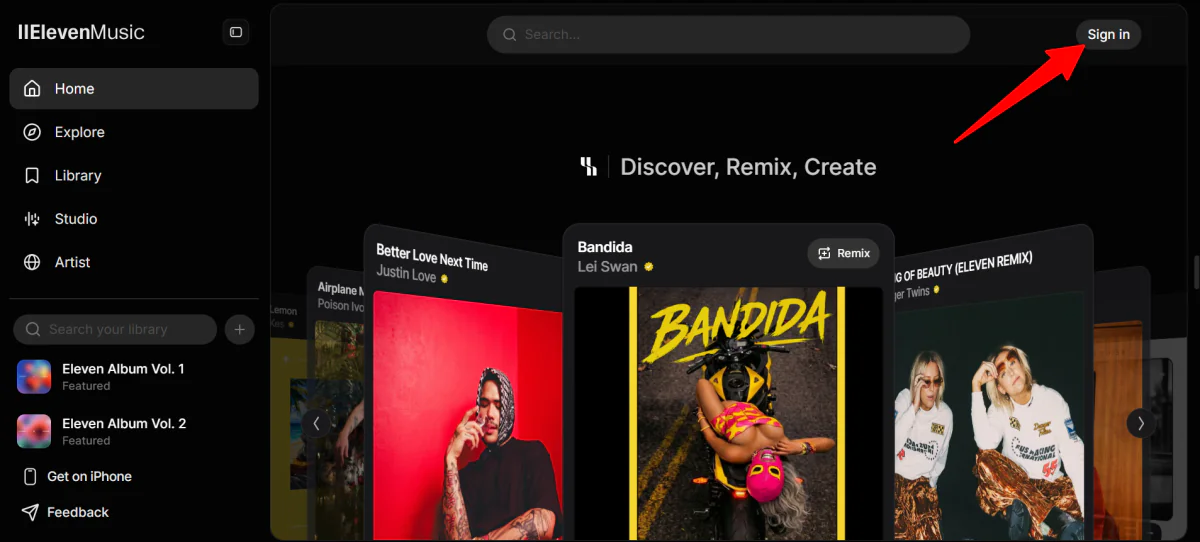
I started by going to
Eleven Music
and selecting “Sign In” on the top right.
Step 2: Explore Music & Artists
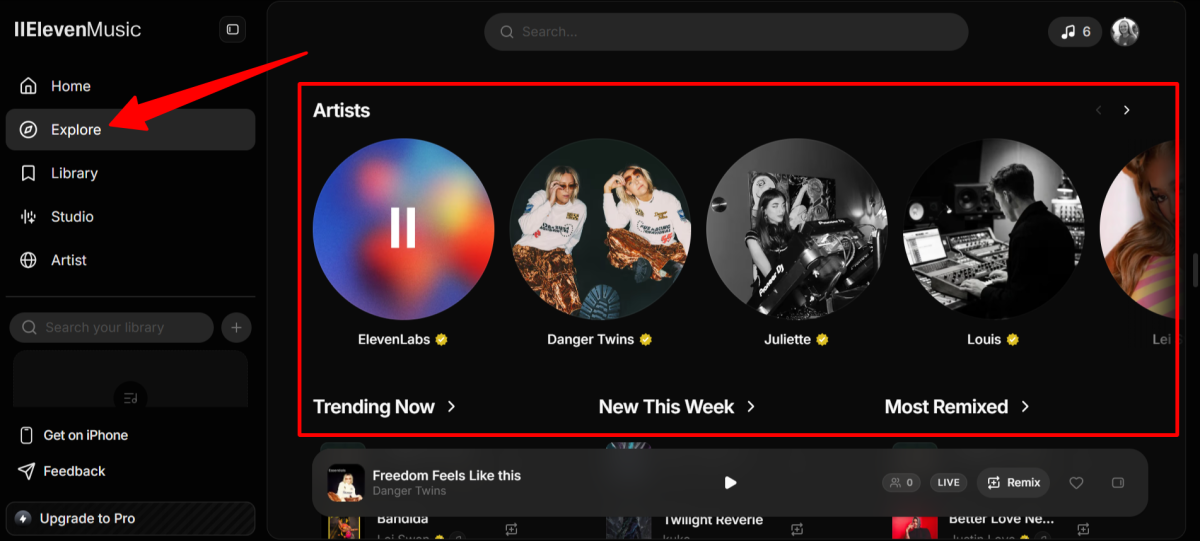
Eleven Music
has a really simple interface that’s easy to navigate.
The “Explore” tab features albums, artists, and songs created with Eleven Music. This is a great resource for finding inspiration before you dive into generating music yourself.
Step 3: View the Library
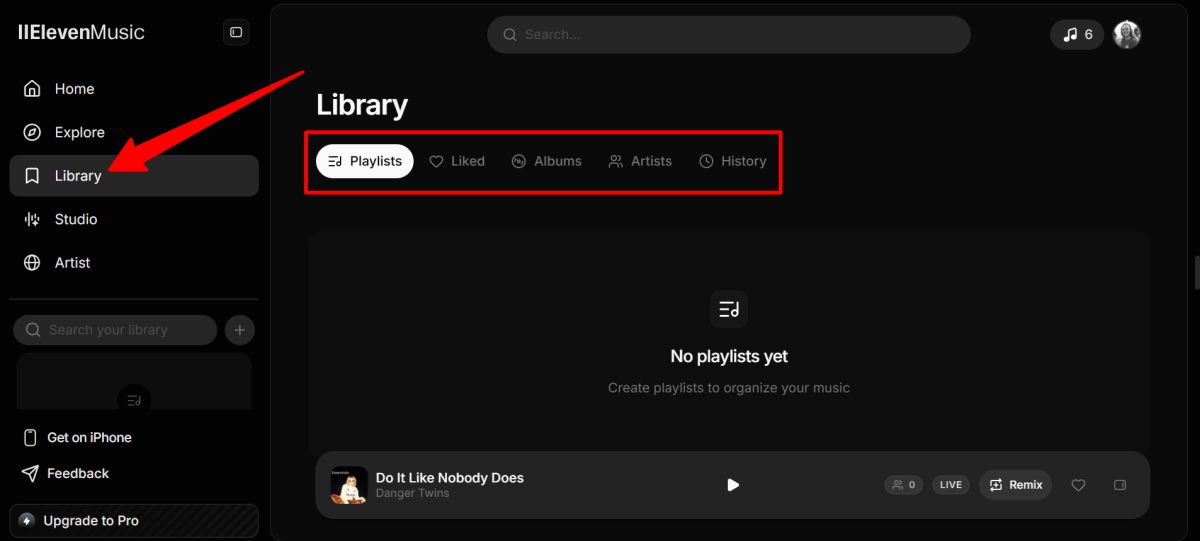
The “Library” tab housed the following:
Playlists: Create playlists to organize your music
Liked: View liked songs
Albums: View saved albums
Artists: View followed Eleven Music artists
History: View listening Eleven Music history
Step 4: Create an Artist Profile
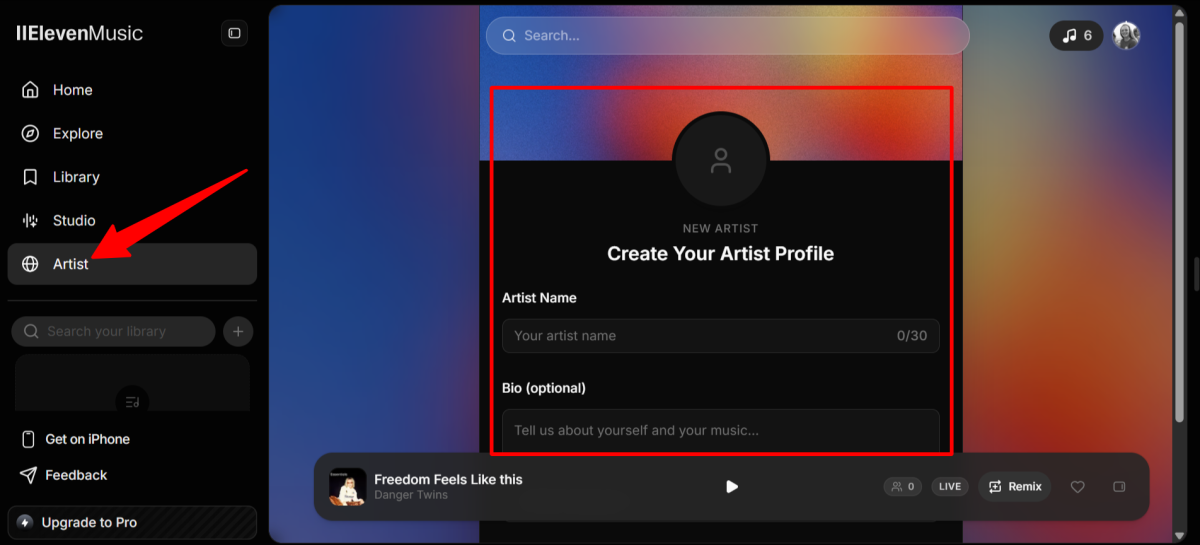
At the bottom of the navigation bar was the ability to create my artist profile:
Profile picture
Artist name (up to 30 characters)
Bio (about the artist and music – optional)
Step 5: Add a Prompt in the Studio
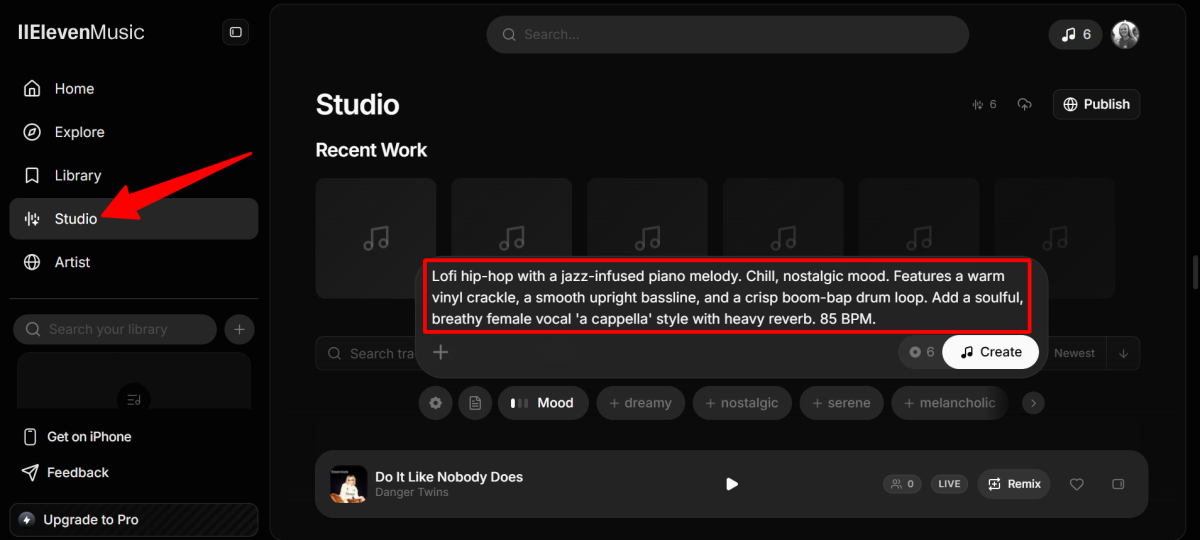
Last but not least was the Studio to describe a song and generate music.
Here’s a useful prompt formula to follow when describing songs to create with
Eleven Music
: [Main Style] + [Specific Mood] + [Detailed Instrumentation] + [Vocal Instruction] + [Technical Tags]
Following this formula, I gave it the following prompt:
“Lofi hip-hop with a jazz-infused piano melody. Chill, nostalgic mood. Features a warm vinyl crackle, a smooth upright bassline, and a crisp boom-bap drum loop. Add a soulful, breathy female vocal ‘a cappella’ style with heavy reverb. 85 BPM.”
Step 6: Tweak the Settings
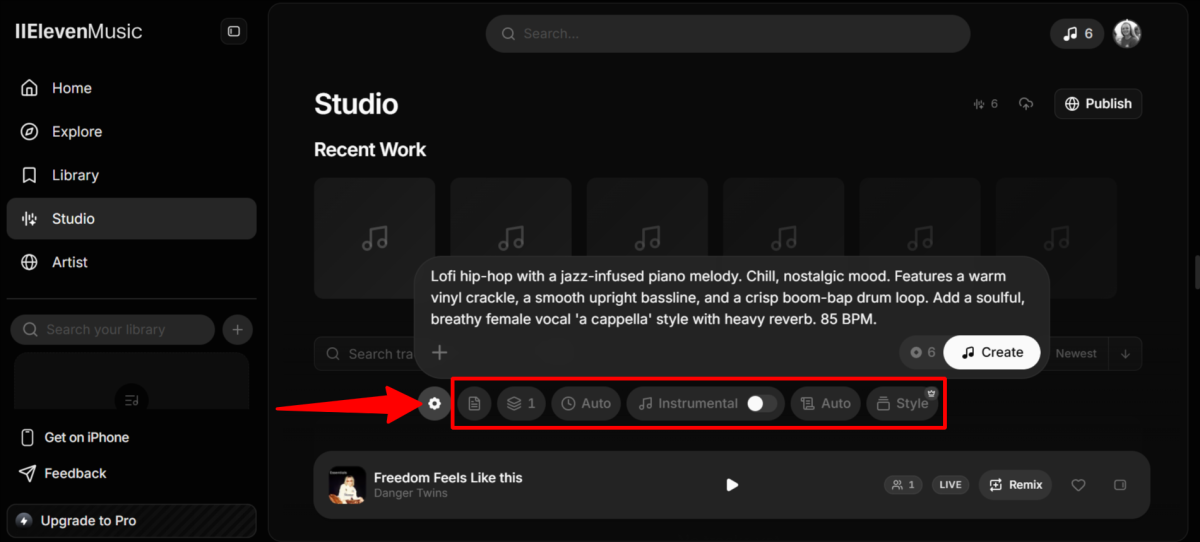
Within the settings (the gear icon), I had the following:
Number of variations (1-4; only 1 on the free plan)
Track duration (Auto or 15 seconds to 5 minutes)
Instrumental toggle (On/Off)
Writing engine (Auto, Deep (Pro), or Fast)
Style (Pro)
I kept the number of variations at 1, track duration on “Auto,” and the instrumental toggle turned off.
Step 7: Generate Lyrics
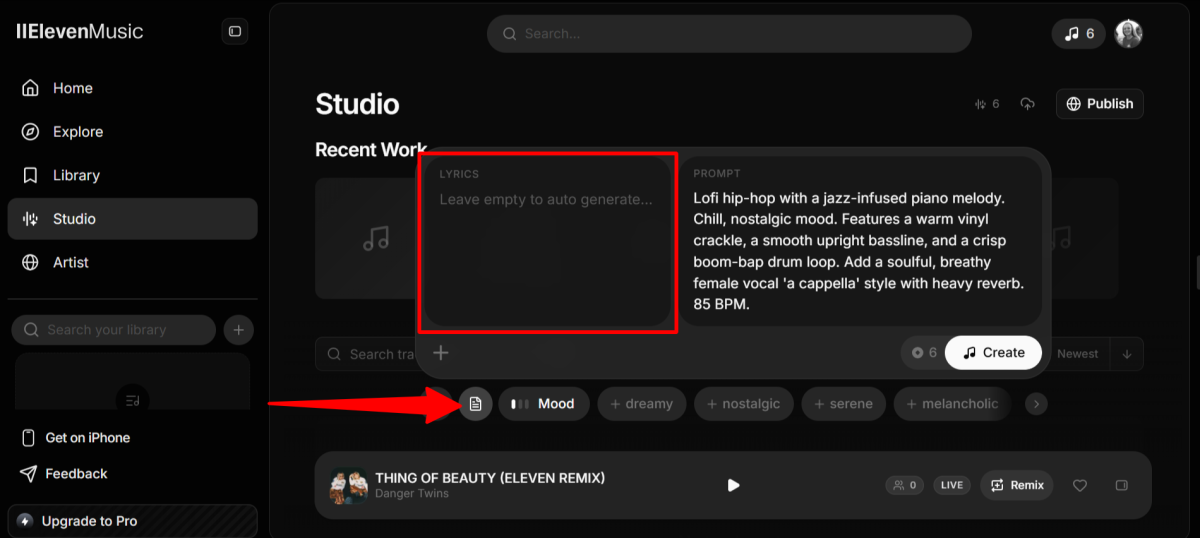
There’s also a little script icon you can click to manually add a script, or leave the field empty for AI to generate lyrics. I selected this and left the field empty to see what the AI would generate.
Step 8: Add Mood, Genre, & Energy
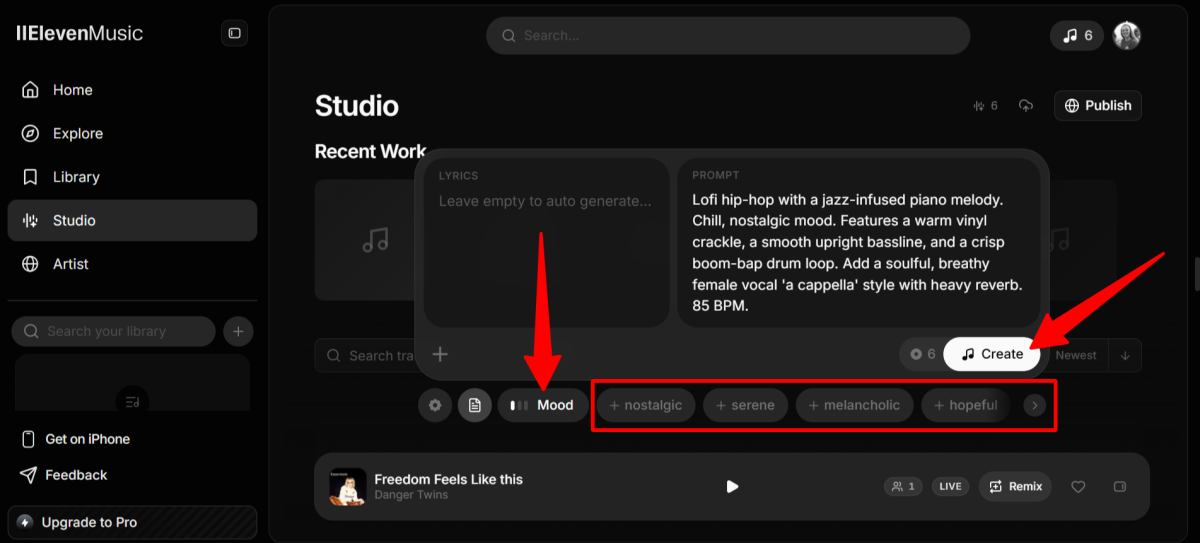
Next to the script icon were Mood, Genre, and Energy. Clicking on any of the suggested words adds it to your prompt.
These are great for quickly shaping the direction of the output without needing to describe everything in detail. They’re not mandatory, so I kept my prompt the same.
Once I was happy with everything, I hit “Create” to start generating.
Step 9: Generate Song & View Lyrics
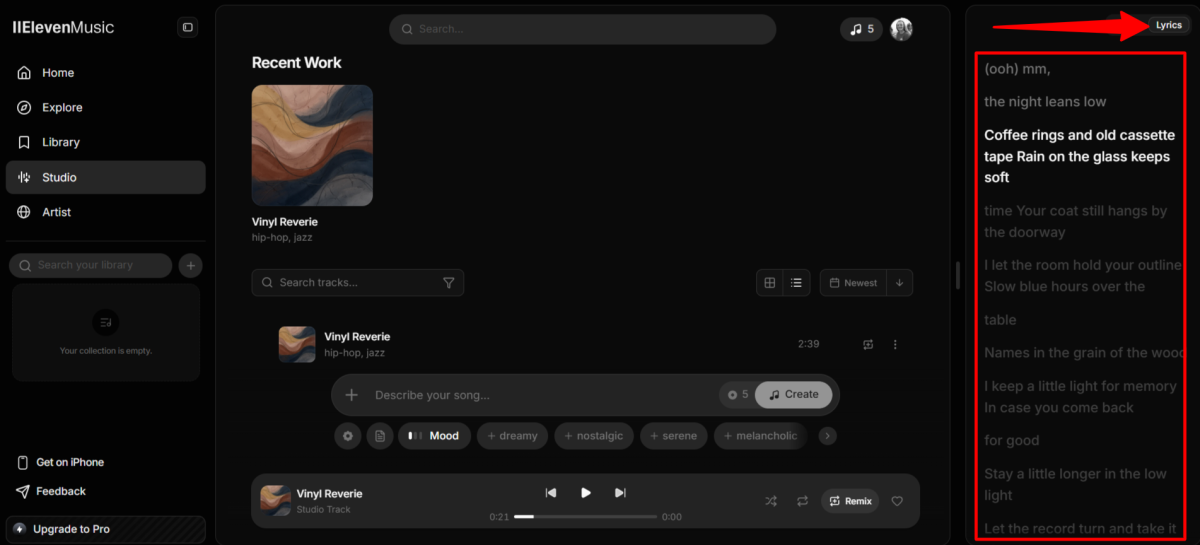
A few seconds later, my song was generated. It was called “Vinyl Reverie.”
Looking at the prompt I gave
Eleven Music
, it nailed it. It sounded authentic, and I could even hear the vinyl “crackle” I included in the prompt.
However, despite being able to preview it as many times as I wanted within Eleven Music, I was unable to download it on the free plan. That’s a pretty big setback since it prevents you from using or sharing the track outside the platform, making it a lot less useful for real projects.
In the panel on the top right was a tab labelled “Lyrics,” where I could view the song lyrics and click on them to find where they were in the song.
Step 10: View Song Menu Options
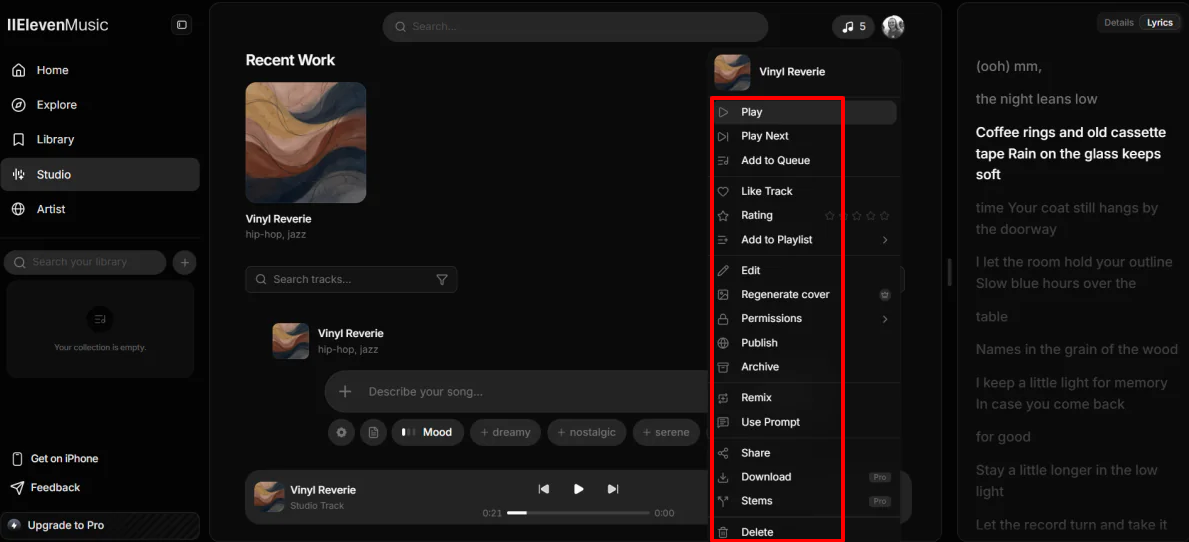
In the menu options on the song (the three dots), plenty of options appeared. I could publish, remix, edit, etc.
Overall,
Eleven Music
made it incredibly easy to go from a simple idea to a fully produced track with little effort. The generated song closely matched my prompt and sounded professional.
It also included useful tools for editing, remixing, and exploring variations immediately after creation. However, it could benefit from a more advanced, in-depth editing suite.
Top 3 Eleven Music Alternatives
Here are the best
Eleven Music
alternatives I’ve tried.
Suno
The first
Eleven Music
alternative I’d recommend is Suno. I’ll tell you a bit about my experience with it to make a proper comparison.
When I first signed up, I went to Simple mode and typed in the most ridiculous prompt I could think of: a pirate shanty about working in a modern IT department. A few minutes later, I had two fully produced songs with lyrics, instruments, and song structure done for me.
But I still wanted to take things up a notch, so I switched to Advanced mode. That’s when things started to get more interesting.
In Advanced mode, I specified my style tags (like “accordion, fiddle, male vocals, 90 BPM” ), pasted in my own lyrics, and even added structural tags like [Chorus] or [Fiddle Solo] to control the energy at specific moments. That level of control made a real difference in the final output.
But the
v5.5 voice feature
was the main thing I wanted to try since it’d been getting a lot of hype lately. I recorded about a minute and a half of myself singing into my laptop mic, and it generated a full indie folk track in my own voice.
I was pretty blown away because it actually sounded like me. That’s not something I expected to be saying about an AI music tool anytime soon.
Both Suno and Eleven Music let you generate full songs from text prompts, so on the surface, they feel similar. But in reality, they’re really built for different things.
On the one hand, Suno is all about speed, creativity, and community. It’s playful, accessible, and great for experimenting. On the other hand, Eleven Music leans harder into professional output, higher audio fidelity, and commercial-use clarity through its Merlin and Kobalt licensing deals.
For quick, fun, and shareable music creation, Suno is a great choice. But for tracks that are ready for production that you can drop into a client video or commercial project without the legal headaches, choose Eleven Music.
Read my
Suno Review
or visit
Suno
!
Udio
The next
Eleven Music
alternative I’d recommend is Udio. Here’s my experience using it.
I started with a bit of a silly prompt: “A song about why the rent is too goddamn high, country, folk.” A few minutes later, I had two fully produced 30-second tracks.
Here’s one of them:
Both had melody, instruments, mood, arrangement, and even AI-generated cover art. If someone had played those for me without context, I would have assumed a real musician made them.
I also tried the Inpaint feature, which I found useful. I selected the first ten seconds of my track, highlighted the corresponding lyrics, and let Udio regenerate just that section.
Udio effortlessly changed how the singer delivered those opening lines. The accuracy was impressive, but I just wished I had a bit more control over how it interpreted the changes.
Both Udio and Eleven Music make it easy to turn a text idea into a finished song, but they have different focuses. On the one hand, Eleven Music leans into audio fidelity, commercial licensing, and developer tools. Meanwhile, Udio is more about creative exploration, remixing, and experimentation.
For professional, commercial-ready tracks, choose Eleven Music. For experimenting and having fun making AI music, choose Udio.
Read my
Udio Review
or visit
Udio
!
Soundraw
The final
Eleven Music
alternative I’d recommend is Soundraw. It’s a bit different from Suno and Udio in that it allows for more granular editing and ensures 100% copyright-safe AI music generation.
Where most AI music tools hand you a finished track and say “good luck,” Soundraw gets you into the weeds. You can tweak instruments, adjust the intensity, restructure the arrangement, and change the track length in real time.
You can even export stems and pull them into a DAW for more granular editing. For creators who want more than just a generated result to work with, that’s a big deal.
The other thing about Soundraw is that it’s trained entirely on in-house compositions, so there’s no ambiguity around copyright. That means no pending lawsuits and no gray areas. Just royalty-free tracks you can drop into a commercial project without a second thought.
However, Eleven Music has the upper hand on Soundraw when it comes to vocal generation, multilingual support, and the Marketplace, where you can earn revenue on your creations. If you need a track with real sung vocals or you’re creating for a global audience, Eleven Music is the stronger choice.
But if you want hands-on control over every element of your track and you need airtight licensing confidence, Soundraw is hard to argue with. It just depends on what you need for your project.
Eleven Music Review: The Right Tool For You?
After trying
Eleven Music
, it’s clear this is one of the stronger AI music tools for quickly turning ideas into full tracks.
The workflow felt smooth from start to finish. I went from a simple prompt to a finished song in minutes, and the result closely matched my vision, right down to subtle details like the vinyl crackle and vocal tone.
With that said, I kept running into one major limitation: the free plan. Not being able to download songs makes it hard to use Eleven Music beyond experimentation. On top of that, it still lacks deeper editing control compared to alternatives and traditional DAWs.
If you’re looking for something with deeper editing features or more creative exploration, consider these alternatives:
Suno
is best for fast, fun, experimental song creation with a strong community.
Udio
is best for creative exploration, remixing, and idea iteration.
Soundraw
is best for creators who want deep control over structure, stems, and arrangement with guaranteed copyright safety.
Overall,
Eleven Music
feels best as a fast creative engine rather than a full production environment. It’s great for generating ideas, testing concepts, or producing tracks for commercial use on paid plans, but less ideal if you want full control over every detail.
Thanks for reading my Eleven Music review! I hope you found it helpful.
Sign up for Eleven Music
to get 6 free generations daily.


