
 五度妙笔
五度妙笔 企业透视镜
企业透视镜 API商城
API商城
 数据库
数据库Intel Nova Lake to Introduce Dual CPU Socket Retaining Arms
Intel is rumored to be working on a newly designed retention system for its next-generation Nova Lake processors. According to VideoCardz's sources, the Nova Lake LGA1851 boards will feature two retaining arms for the CPU bracket, locking it in place on both sides. This reportedly delivers a flatter CPU, improving contact between the integrated heat spreader (IHS) and the CPU cooler's cold plate.
The two-lever independent loading mechanism, or 2L-ILM for short, will be exclusive to enthusiast motherboards, making it a premium addition for those who want the flattest CPU possible. Considering this is unlikely to have a dramatic effect on the cooling potential, that's probably a wise call. Gamers buying prebuilts won't care if their CPU has reached true level, but overclockers pushing the very limits of what their chip can do may take notice.
This isn't the first time Intel has tweaked its CPU socket mounting system, though. Although Alder Lake and Raptor Lake used the traditional retention arm mounting system, Intel also offered newer RL-ILM socket systems with high-end LGA1851 motherboards for the Arrow Lake generation of chips.
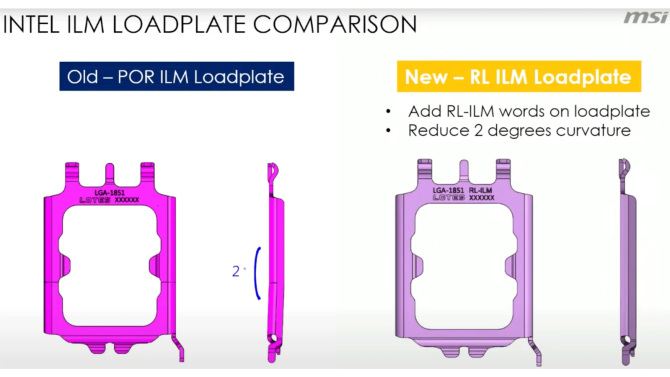
Credit: MSI
That RL-ILM used new insulators for the hinge and frame and reduced the bending of the IHS by about 2 degrees. Testing by GamersNexus found that this could actually improve temperatures by around two degrees—a near 3% improvement. With coolers designed for this new kind of socket system, that could be improved further.
This is something enthusiasts have been aware of for a while, though. That's why some companies that make overclocking accessories have offered their own cooler contact frames for a while.
But it seems Intel believes the socket design process can also be reworked to achieve even flatter IHS results. Intel did use this before with its older LGA-2011 motherboards, but moved away from it in subsequent generations. If going back to that design can result in an even flatter surface to attach the cooler to, and coolers are designed with flatter cold plates in turn, perhaps we'll see even better temperatures next generation.


